
post updated June 2026, originally published July 2005
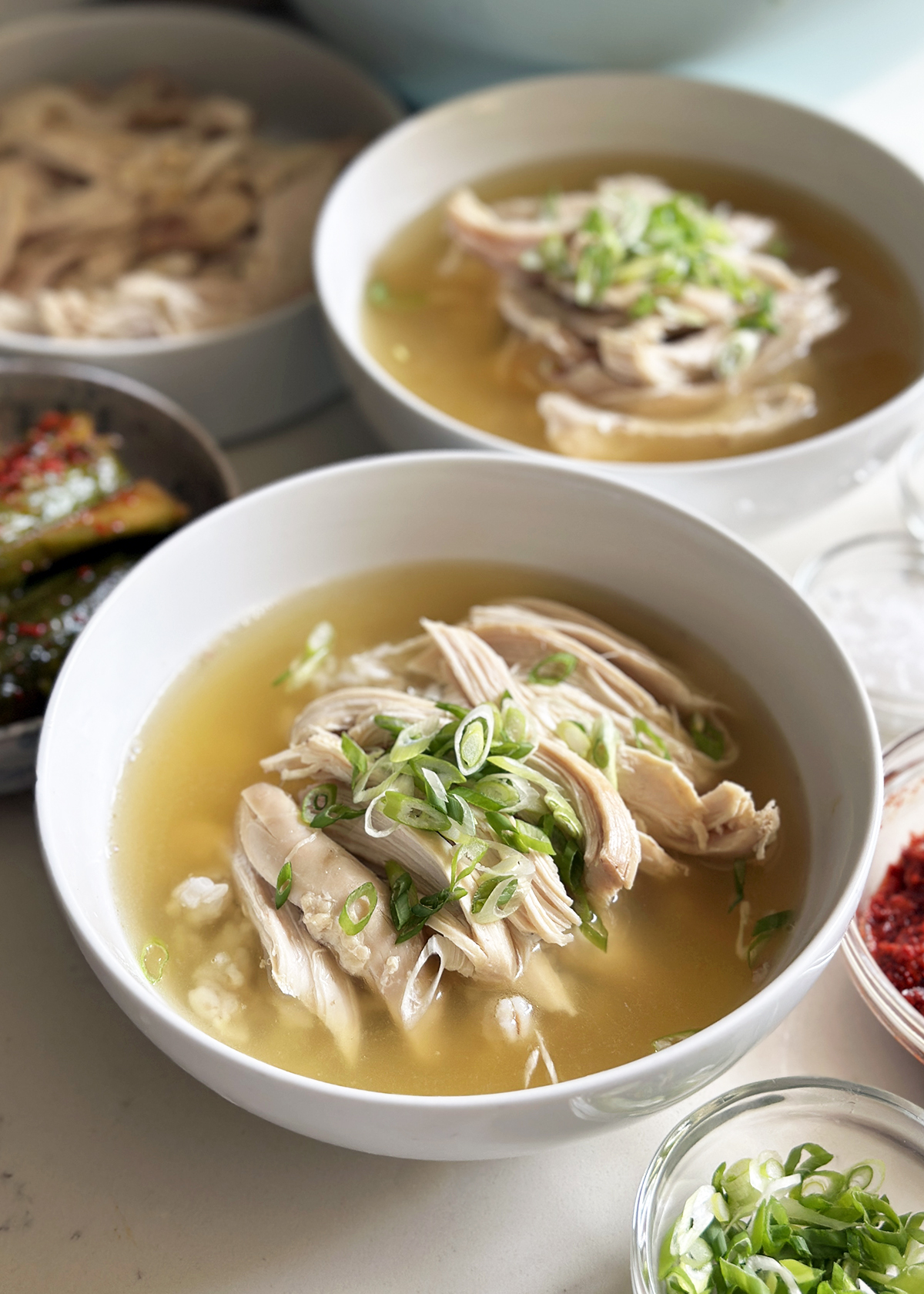
Explore More
What Ingredients You Need to Make Korean Chicken Soup
for Chicken Soup
- chicken, 3½-4 pounds
- garlic, 10-12 cloves, which is about 1 small medium bulb, peeled and lightly smashed with the side of a chef's knife
- ginger, 1 1-inch piece peeled and sliced
- white or yellow onion, ½ medium peeled and root end cut off
- green onions, 2 cut into 2-inch long pieces, 3 finely chopped to serve, so 5 total
- cooked rice, 4 cups (1 cup per serving)
optional: extra leftover chicken bones from your freezer to flavor the soup broth
To Serve Korean Chicken Soup
- flaky sea salt
- black pepper
Spicy Korean Chili Paste Seasoning to Serve
- gochugaru, 4 tablespoons
- garlic, 2 cloves finely minced, ~ 2 teaspoons
- soy sauce or tamari, 1 tablespoon
Should You Wash Raw Chicken Before Cooking?
tl;dr No, you should NOT wash raw chicken before cooking.
The world is, like with so many things, divided over whether you should wash raw chicken before cooking. While my cultural and generational instinct is to wash it, I stand firmly with both the USDA and the CDC on the side of DO NOT WASH because whatever bacteria you think you're washing off will be killed by fully cooking the chicken.
The ONLY time you might want to wash chicken is IF and only IF a butcher has cut chicken into pieces for you and you want to rinse off potential shards of bone. Even then, you can carefully inspect the chicken and remove the bone fragments by hand with a paper towel.
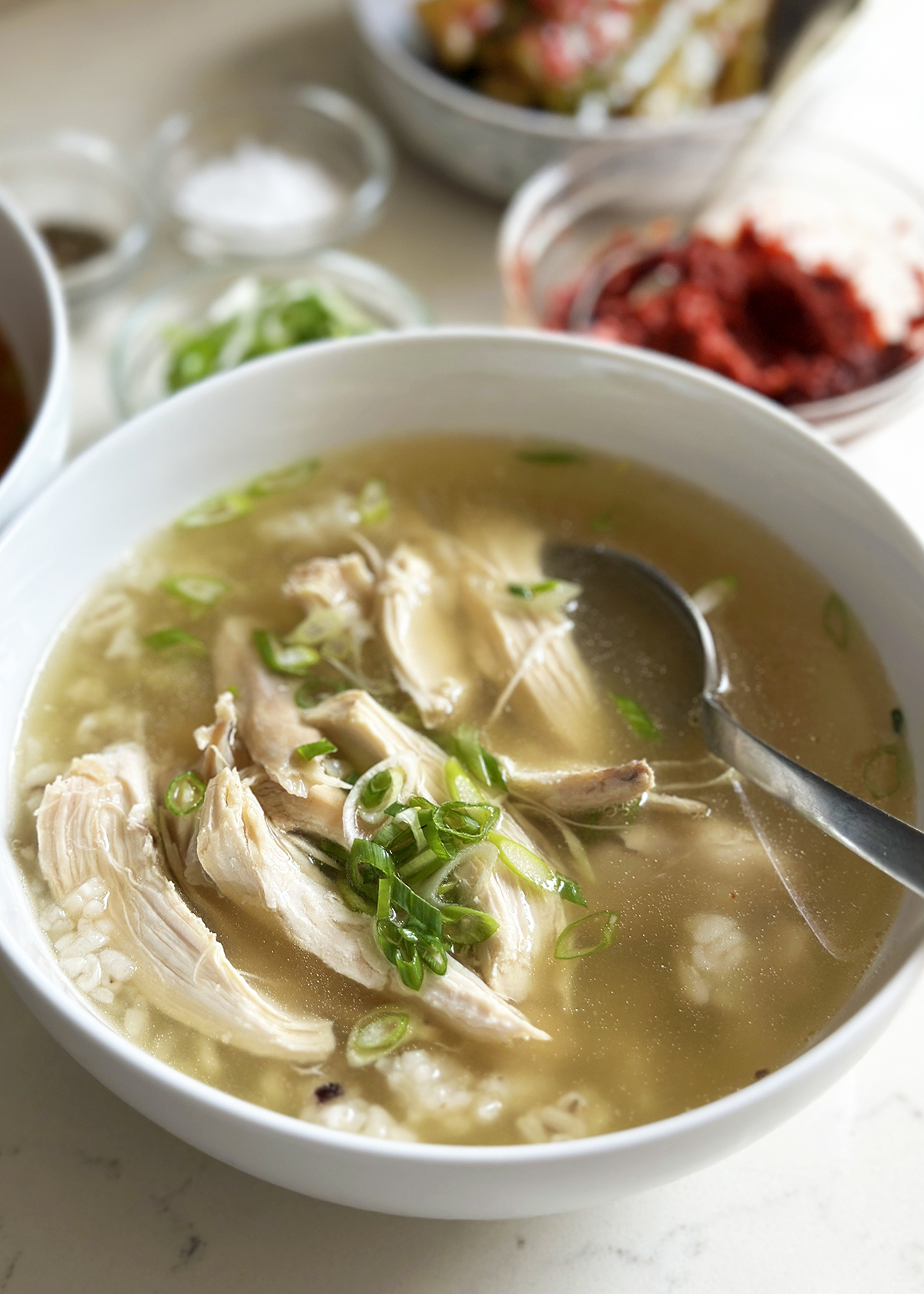
How to Make Korean Chicken Soup aka Dak Gom Tang
Make the Korean Chicken Soup ~ 50-60 minutes
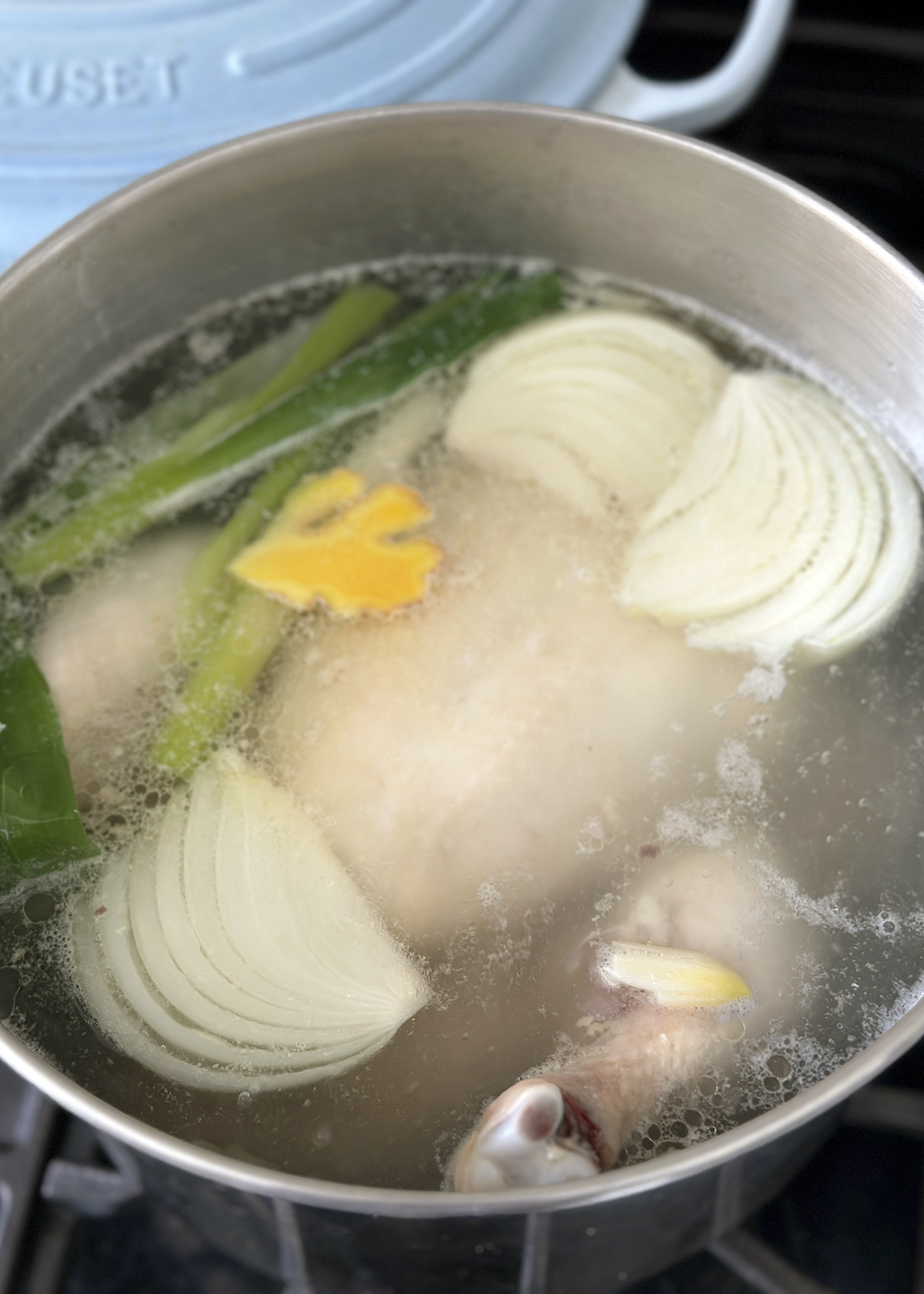
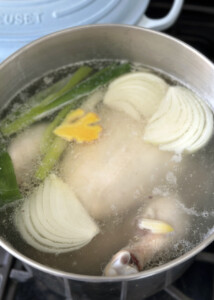
In a pot large enough for 1 3½-4 pound chicken plus water to completely cover it by at least 2 inches, place the chicken, 10 - 12 cloves garlic lightly smashed with the side of a knife, 1 1-inch piece ginger, ½ medium white or yellow onion, 2 green onions cut into 2-3 inch pieces, and 10-12 cups of water.
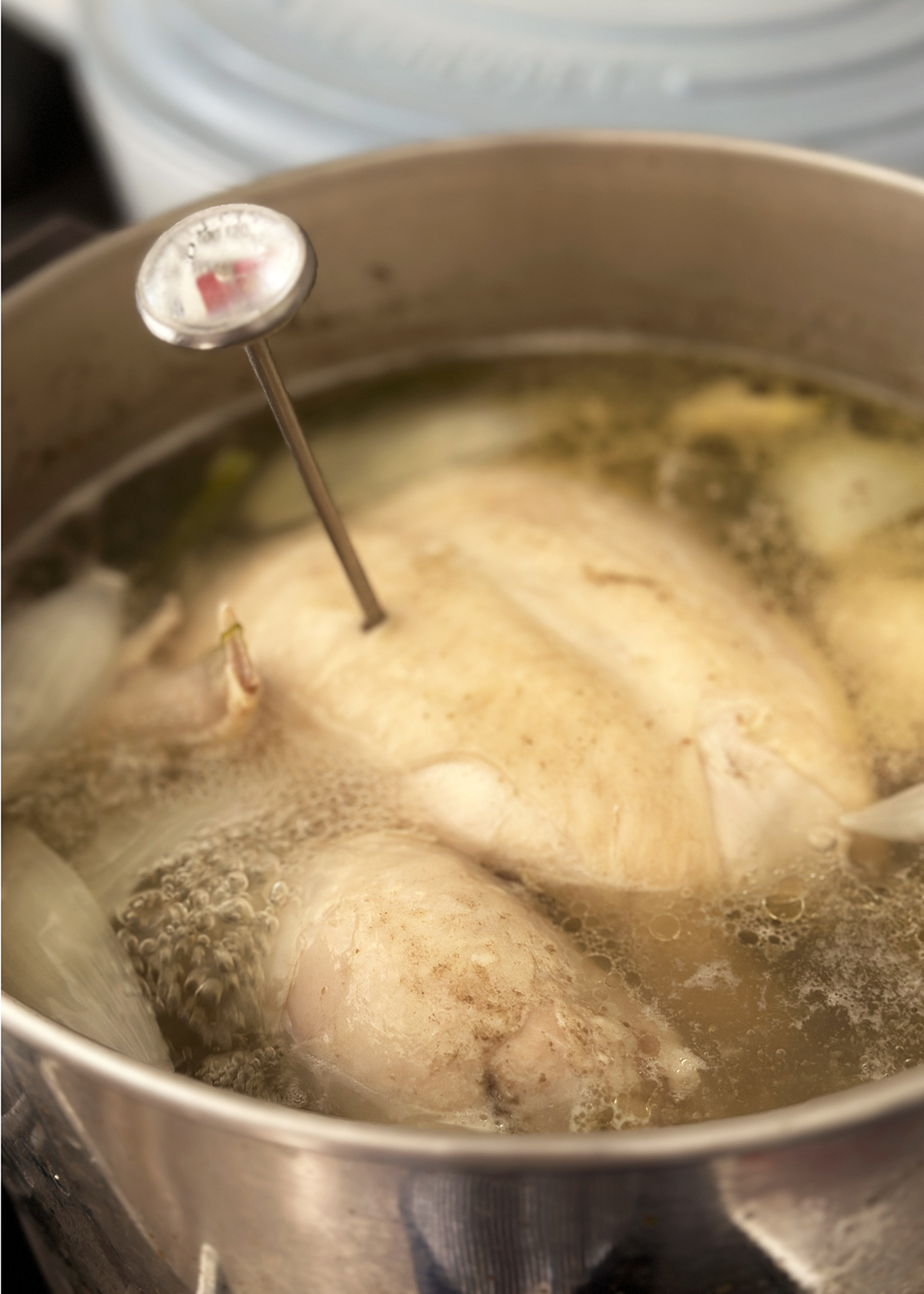
Bring the contents of the pot to a rolling boil over high heat. Reduce the heat to medium-low, cover the pot with a lid, tilting it slightly to create a small vent for steam, and gently simmer for 50 minutes to 1 hour, until the chicken is completely cooked through, or until the chicken reached 165°F.
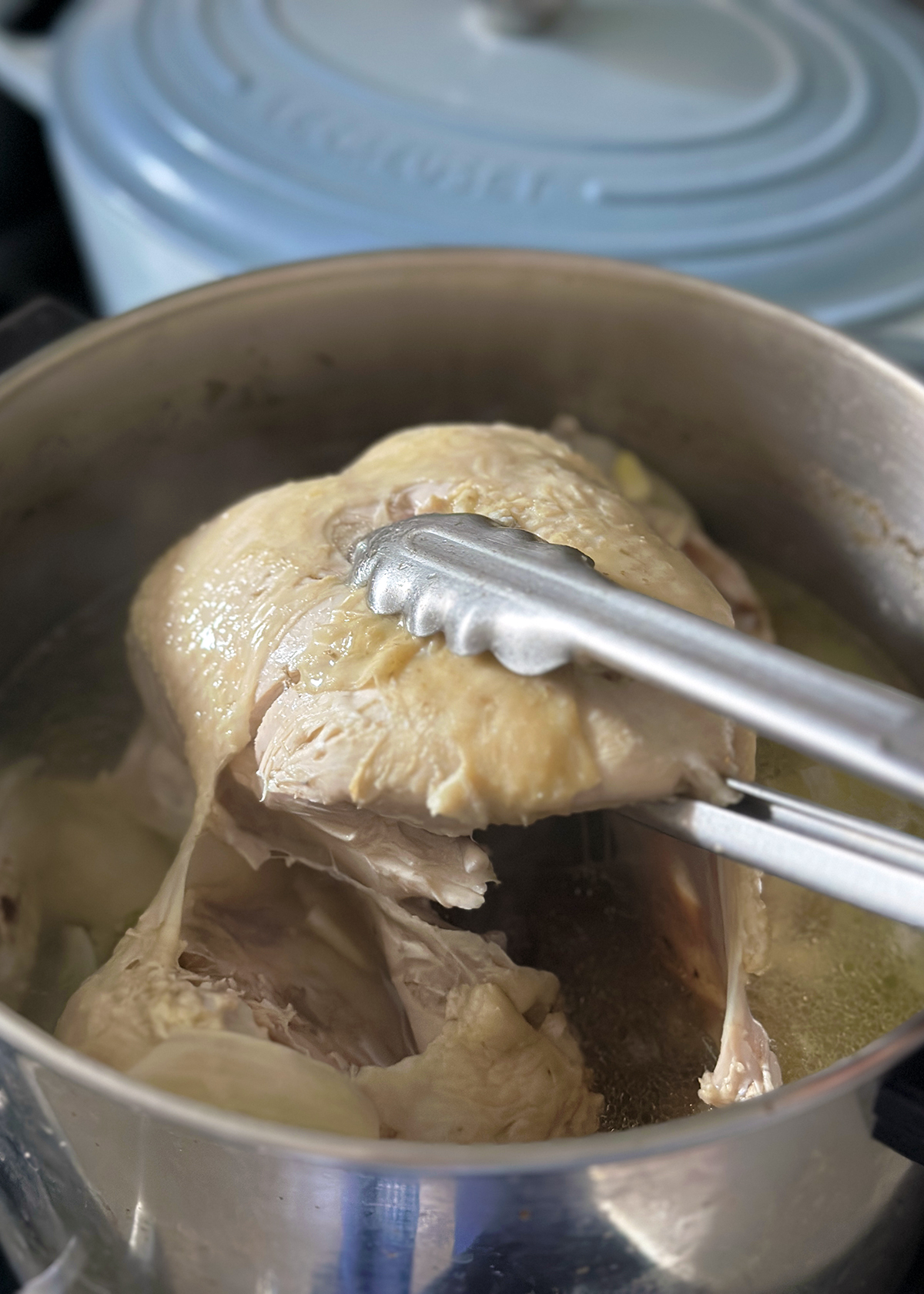
Turn the heat off. Remove the chicken to a large plate or cutting board. You can do this with 2 very large spoons or spatulas, or tongs.
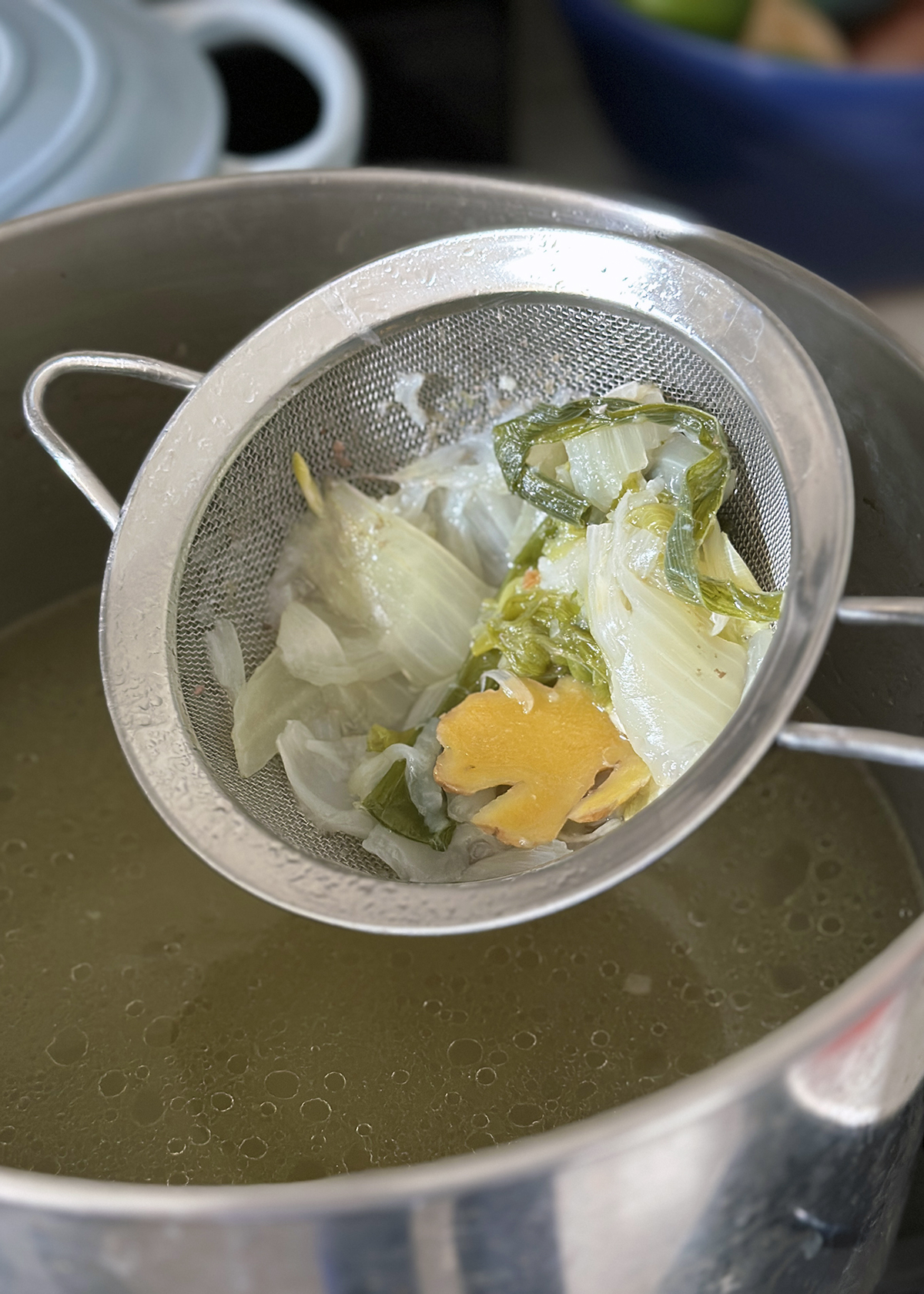
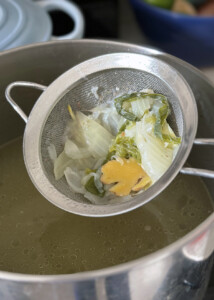
Fish out the garlic, ginger, onion, and green onions from the pot and discard, leaving the chicken stock in the pot.
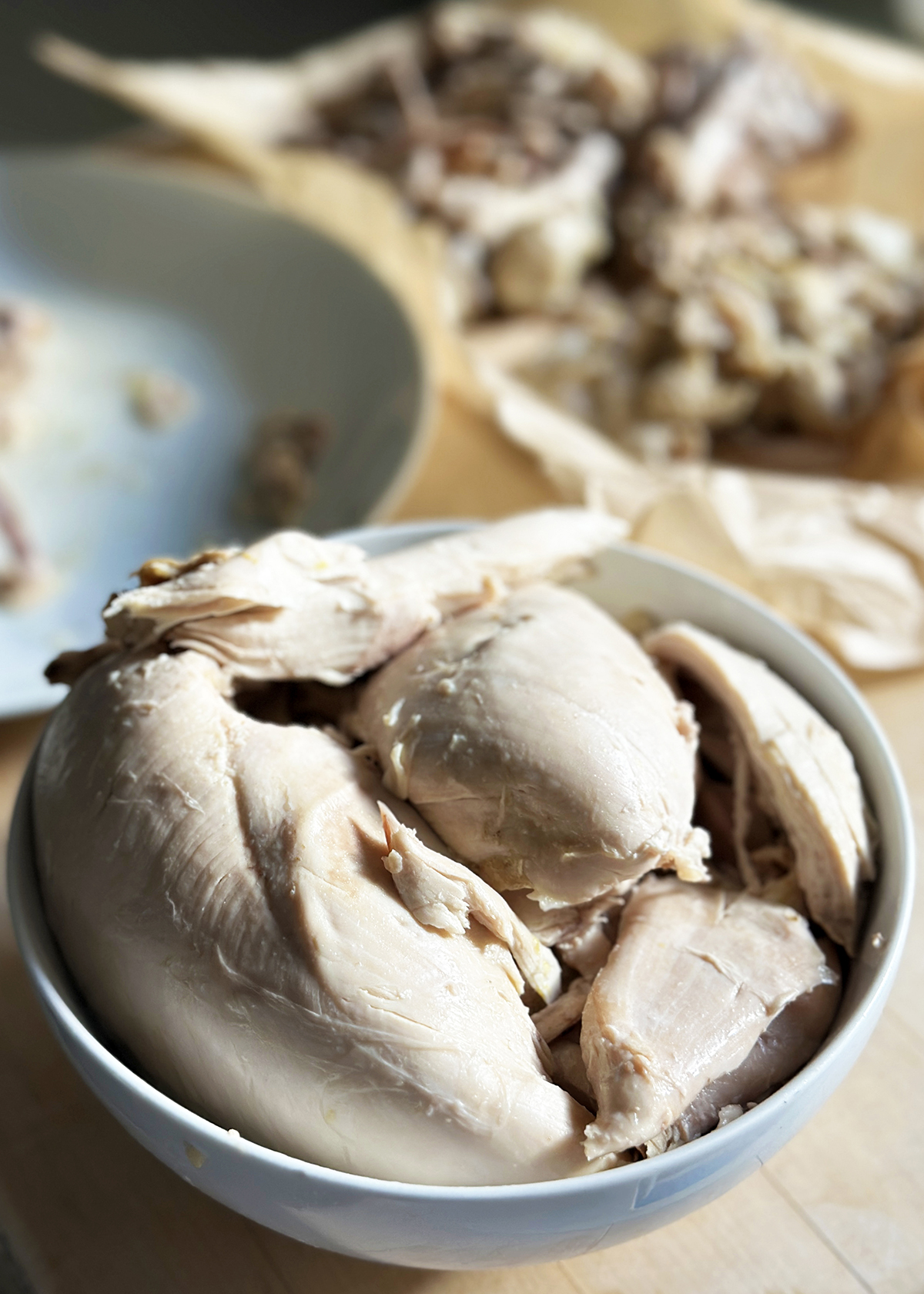
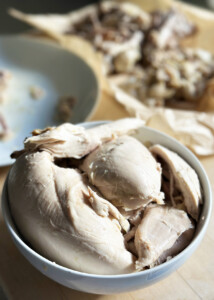
When the chicken is cool enough to handle, pull the meat off the bones, discarding the skin. Remove the chicken meat to a separate plate or bowl, cover, and refrigerate.
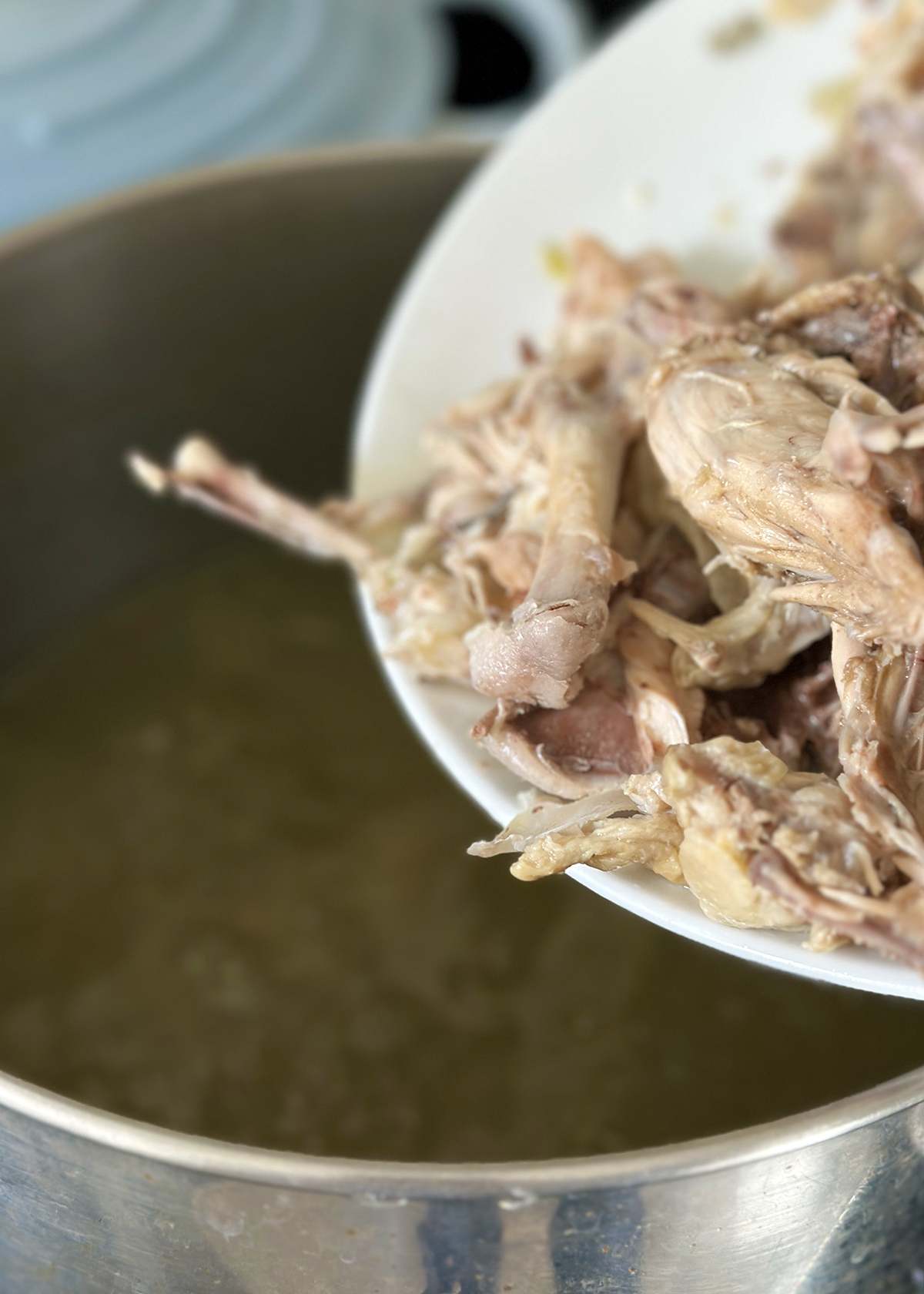
Place the bones back into the pot with the broth. If you have extra leftover bones in your freezer, this is a great time to add those, too! Turn on the heat to high and bring the pot to a rolling boil. Turn the heat back down to medium low, cover, and simmer the bones for an additional 30 minutes to 1 hour to enrich the broth with additional flavor.
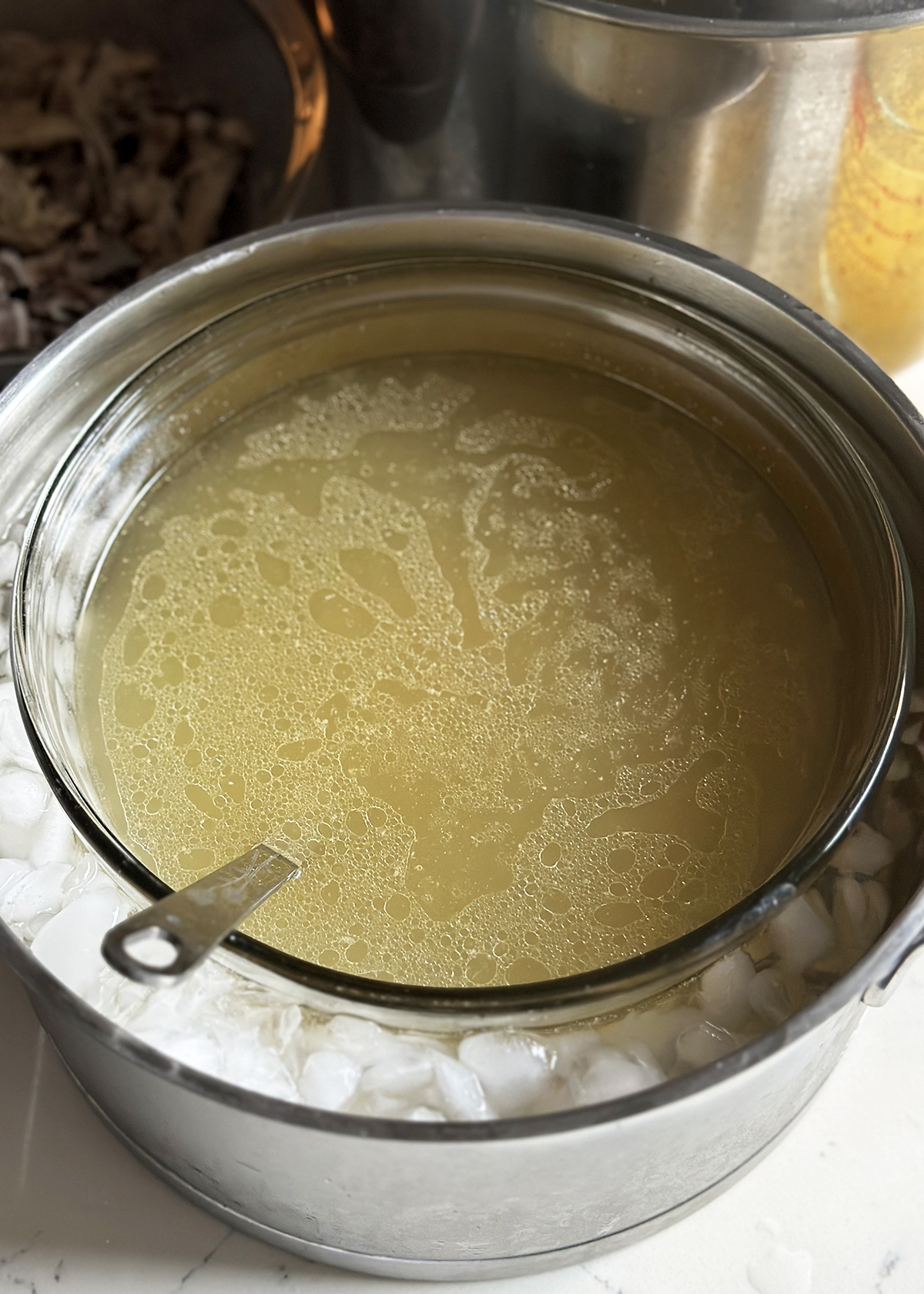
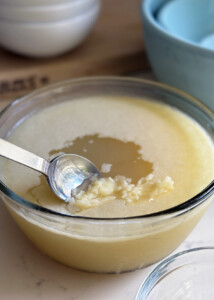
Turn off the heat. Strain the stock. Remove rendered fat by carefully skimming it off the surface with a large spoon or using a fat separator.
Optional Overnight Chilling: Turbo-cool the stock in an ice bath.
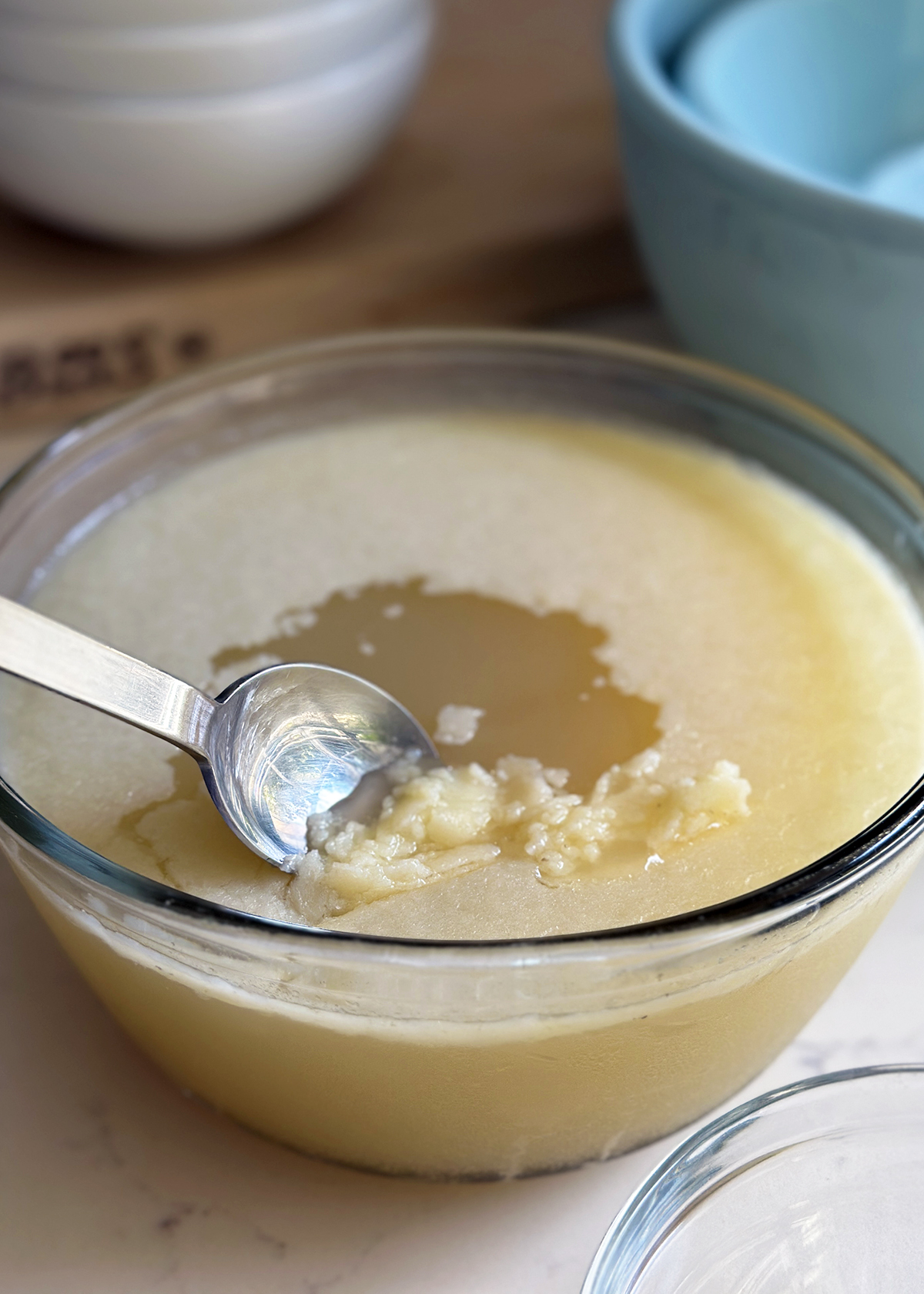
Then refrigerate the cooled stock overnight for the fat to solidify. The broth will gel, and you can remove the soldified fat from the top layer.
When Ready to Serve Korean Chicken Soup
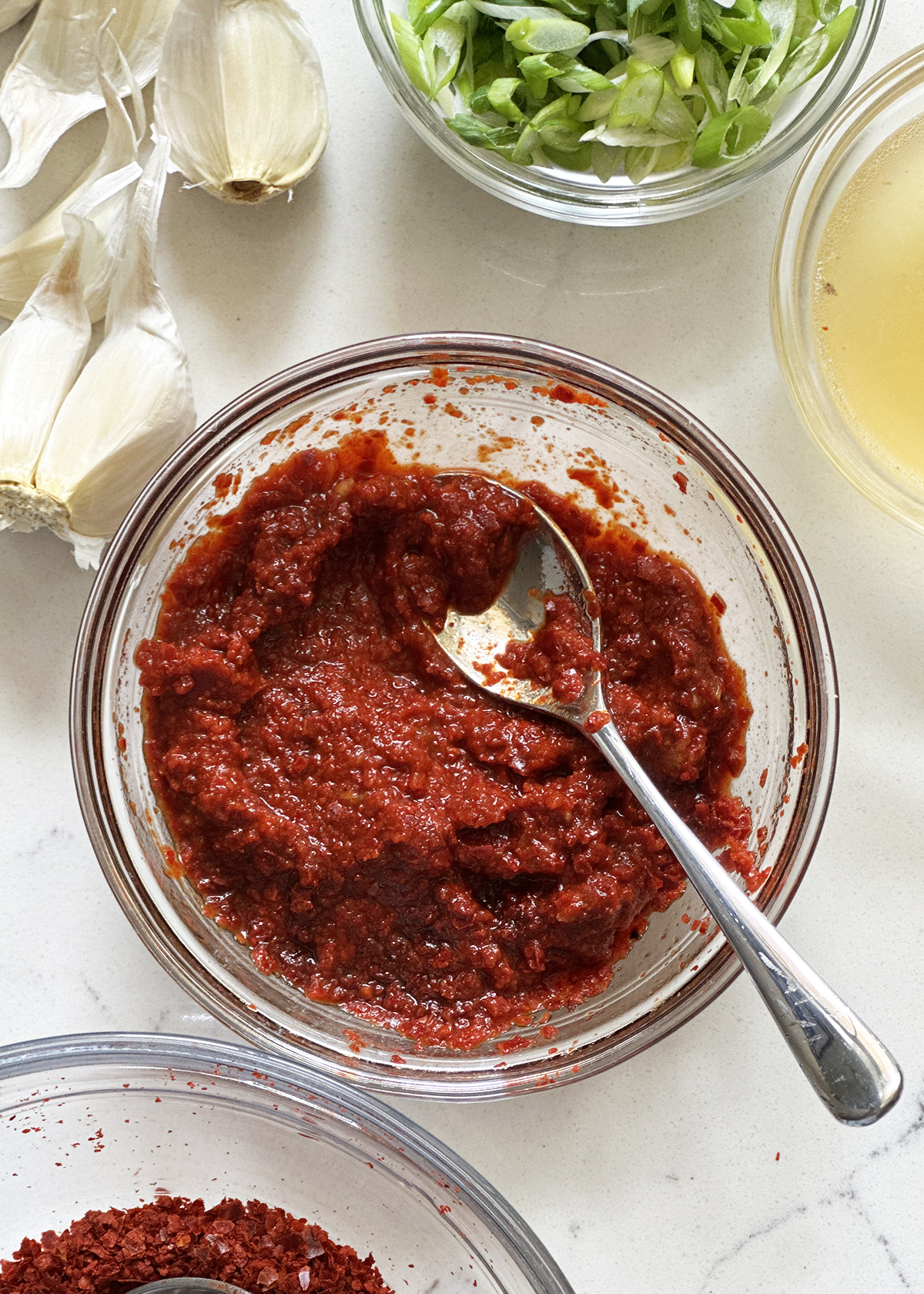
Make Spicy Korean Chili Paste Seasoning: Combine 4 tablespoons gochugaru, 2 cloves garlic minced, 1 tablespoon soy sauce, and 4 tablespoons chicken broth from the soup in a small bowl.
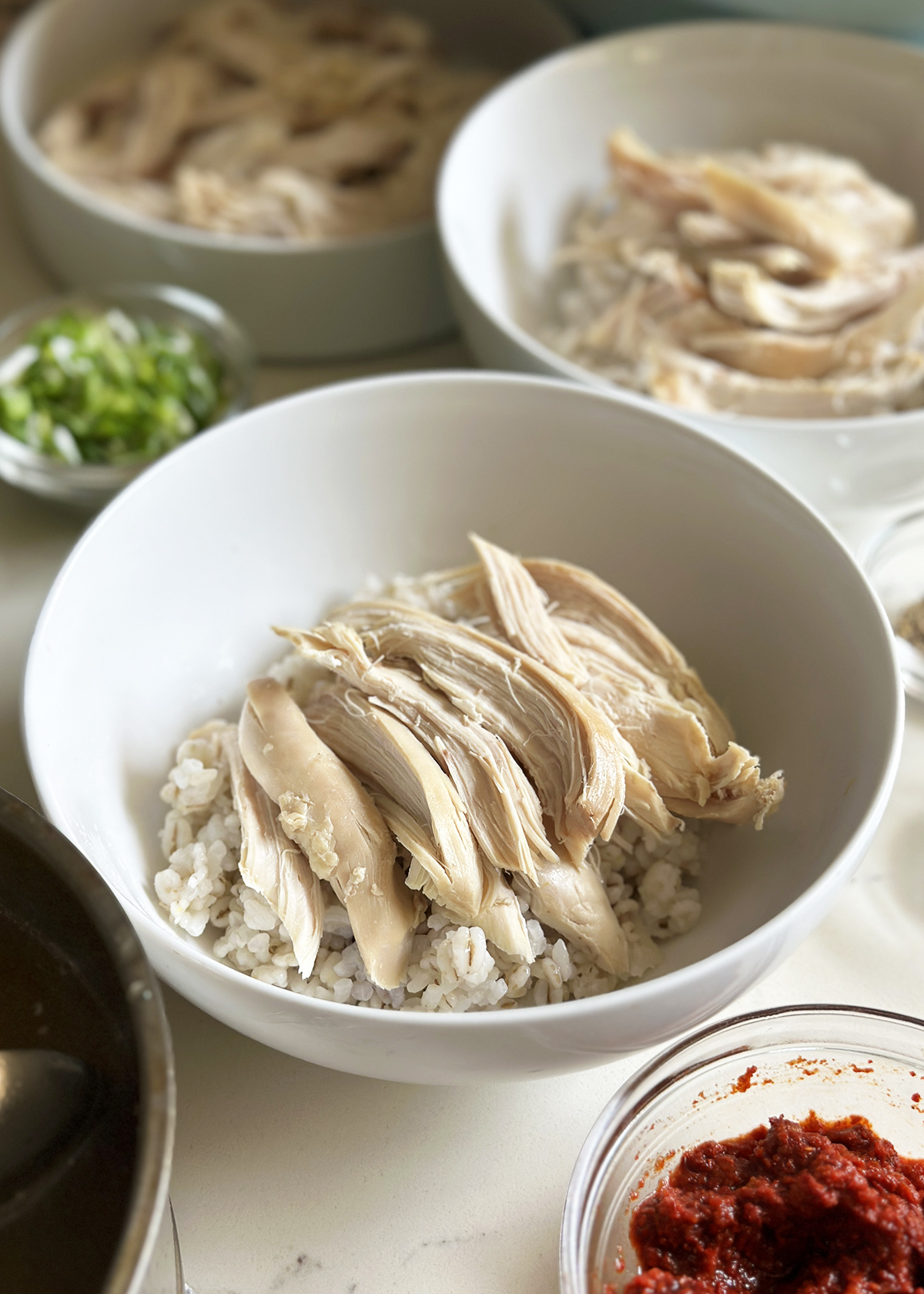
When ready to serve, bring the broth back to a boil to re-heat.
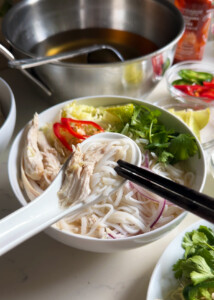
Place 1 cup cooked rice in each serving bowl, add chicken pieces. You can also serve the rice hot in a separate bowl or plate on the side.
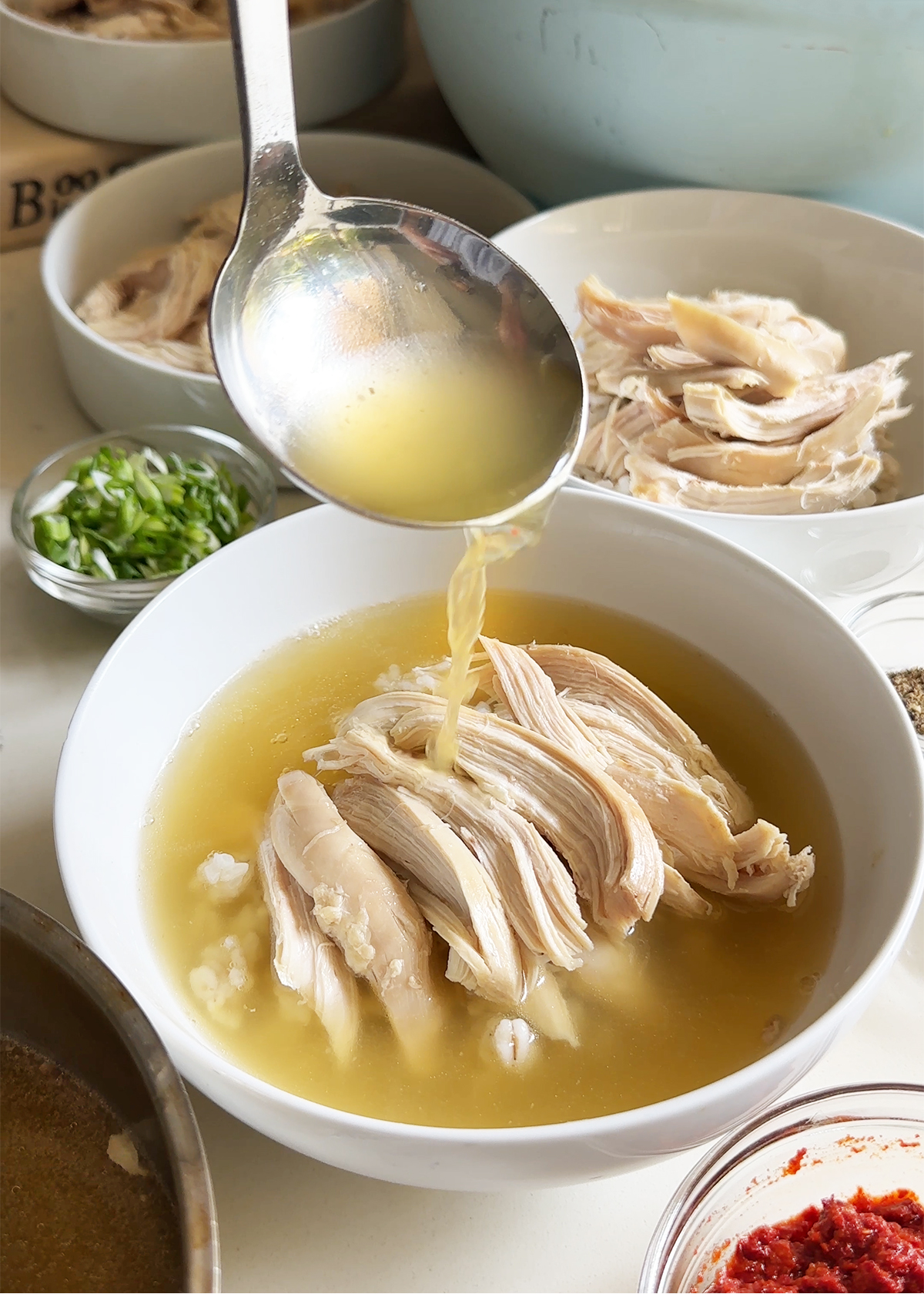
Ladle the hot broth over chicken in each bowl.
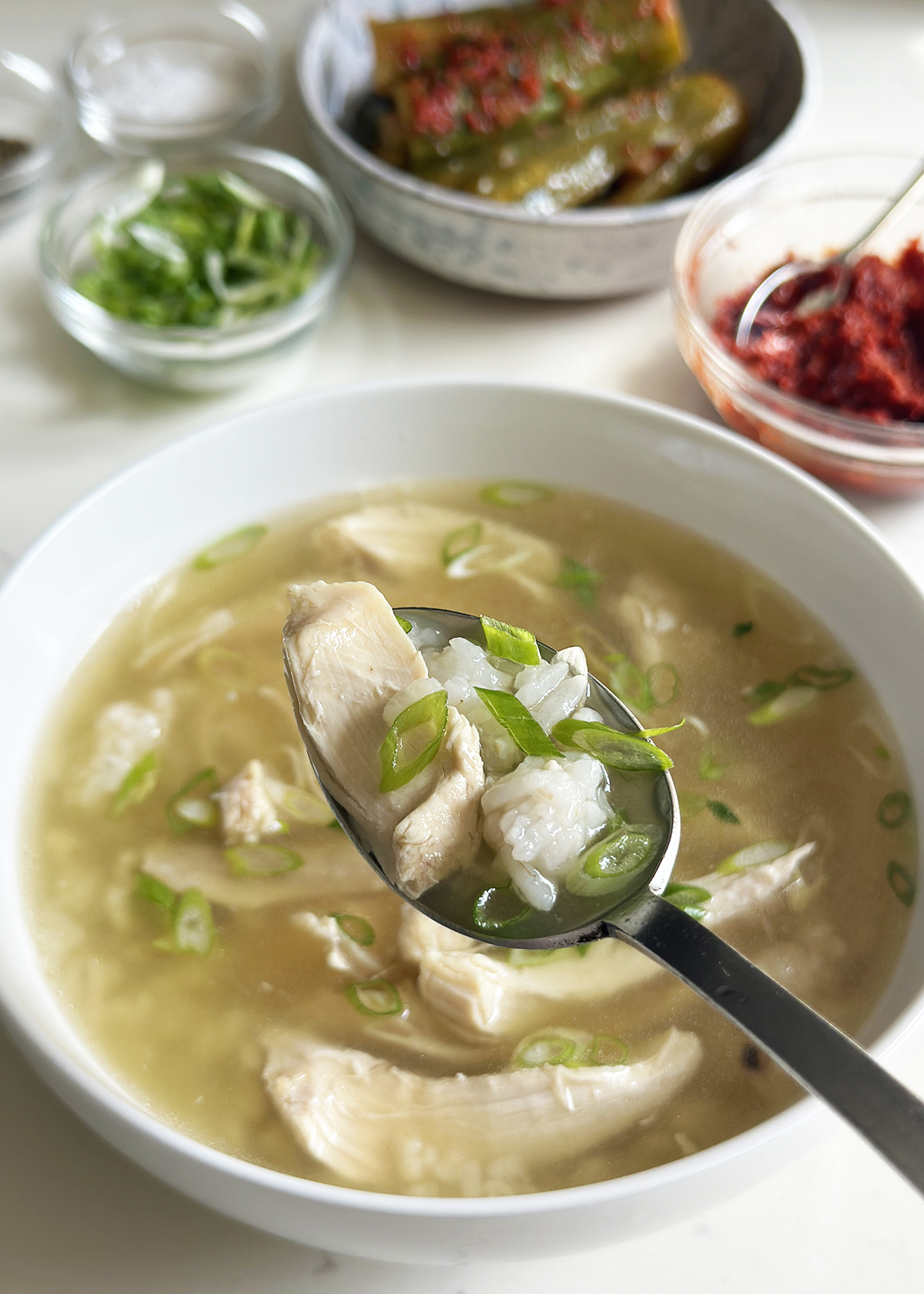
Serve with chopped scallions, salt and pepper, and optional Spicy Korean Chili Paste Seasoning so each person can season their individual bowl of Korean Chicken Soup to taste.
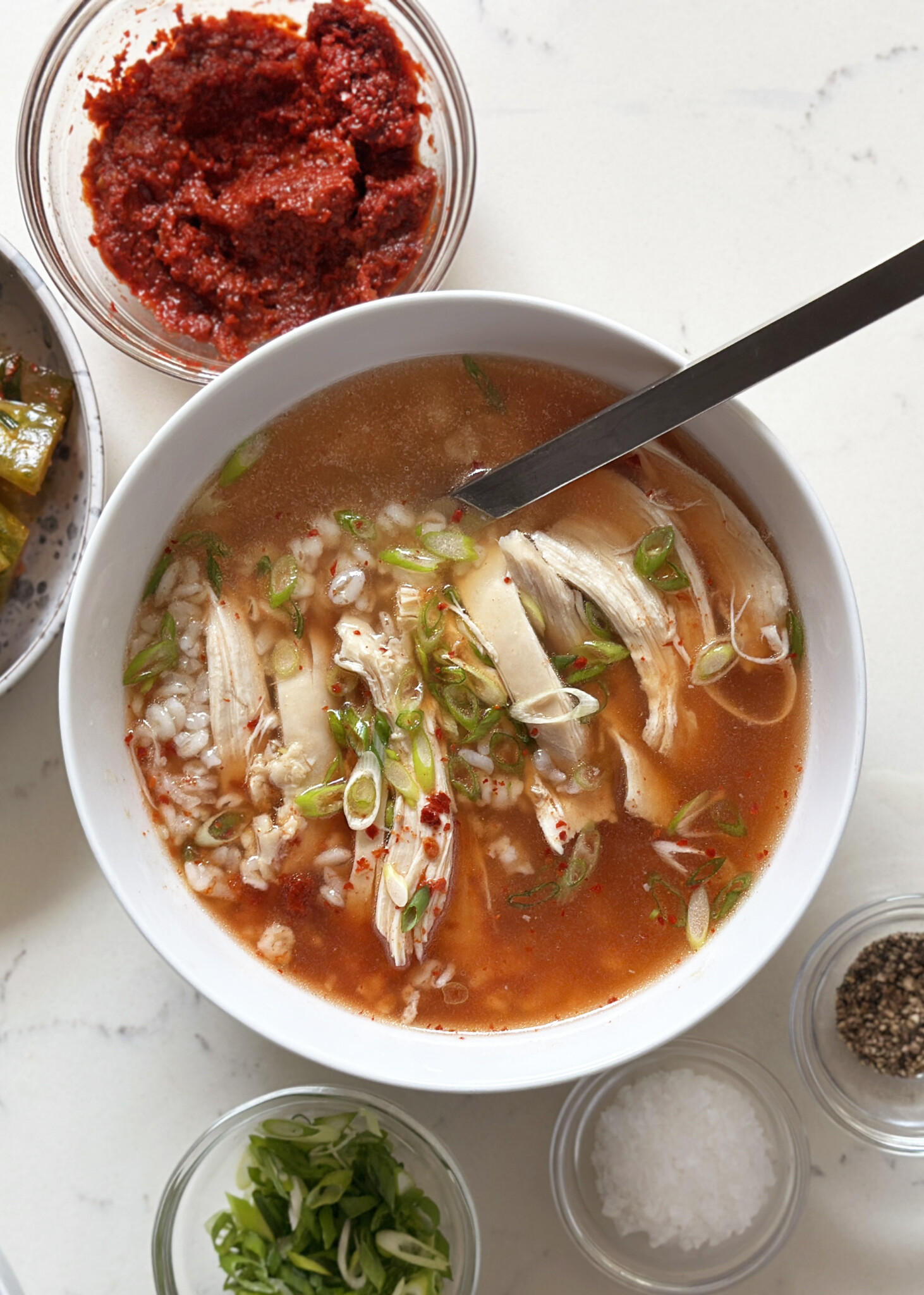
How to Serve and Eat Korean Chicken Soup
No one tells you how to eat a bowl of regular shmegular chicken soup, and the same is true for a steaming hot bowl Korean Chicken Soup! Enjoy your bowl of soup the way you like it! The salt and pepper, chopped green onions, and Chili Paste are served alongside so you can season your own bowl.
However, here are a couple of tips for how I, as a fire-eating spice monster, like to eat mine:
- Season the soup in your bowl with a couple of large pinches of salt, since the main broth in the pot is only very subtly salted.
- Stir a very generous spoonful of the Korean Chili Paste Seasoning directly into the bowl to make it spicy.
- Scoop up a bite of rice with the broth in your spoon, grab a piece of chicken with your chopsticks, dip it in the chili paste, and add it to your spoon for a doubly spicy bite!
Korean Chicken Soup Health Benefits
Depending on your health and dietary needs, Korean Chicken Soup can be part of a healthy lifestyle! The health benefits come from the clean, aromatic bone broth, micronutrients and antioxidants in the garlic ginger, and green onions, and the chicken's protein.
As published, this recipe for Korean Chicken Soup is:
- dairy-free
- gluten-free, if using gluten-free soy sauce or tamari
Best Brothy Comfort Food Recipes


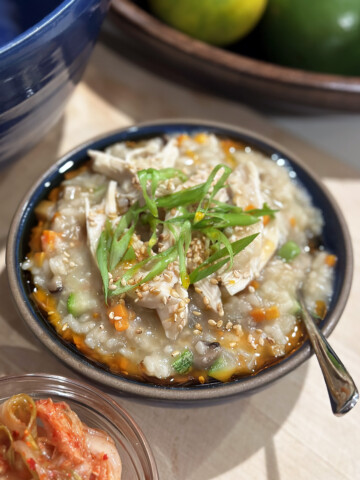
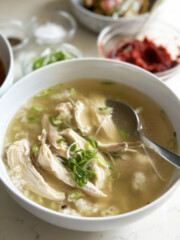
Dak Gom-tang, Korean Chicken Soup Recipe
Ingredients
for Chicken Soup
- 1 3½-4 pound chicken
- 10 - 12 cloves garlic peeled and lightly smashed with the side of a chef's knife, ~ 1 small medium bulb
- 1 1-inch piece ginger peeled and sliced
- ½ medium white or yellow onion peeled and root end cut off
- 2 green onions cut into 2-inch long pieces
- optional: extra chicken bones for chicken soup stock
- 4 cups cooked rice
To Serve Korean Chicken Soup
- 3 green onions finely chopped to garnish
- flaky sea salt and coarse ground pepper option
- Spicy Korean Chili Paste Seasoning (ingredients below)
Instructions
Make Korean Chicken Soup ~ 2 hours, plus overnight if cooling chicken broth
- In a pot large enough for 1 3½-4 pound chicken plus water to completely cover it by at least 2 inches, place the chicken, 10 - 12 cloves garlic lightly smashed with the side of a knife, 1 1-inch piece ginger, ½ medium white or yellow onion, 2 green onions cut into 2-3 inch pieces, and 10-12 cups of water.

- Bring the contents of the pot to a rolling boil over high heat. Reduce the heat to medium-low, cover the pot with a lid, tilting it slightly to create a small vent for steam, and gently simmer for 50 minutes to 1 hour, until the chicken is completely cooked through, or until the chicken reached 165°F.
- Turn the heat off. Remove the chicken to a large plate or cutting board. You can do this with 2 very large spoons or spatulas, or tongs. Fish out the garlic, ginger, onion, and green onions from the pot and discard, leaving the chicken stock in the pot.
- When the chicken is cool enough to handle, pull the meat off the bones, discarding the skin. Remove the chicken meat to a separate plate or bowl, cover, and refrigerate.
- Place the bones back into the pot with the broth. If you have extra leftover bones in your freezer, this is a great time to add those, too! Turn on the heat to high and bring the pot to a rolling boil. Turn the heat back down to medium low, cover, and simmer the bones for an additional 30 minutes to 1 hour to enrich the broth with additional flavor.
- Turn off the heat. Strain the stock. Remove rendered fat by carefully skimming it off the surface with a large spoon, using a fat separator, or turbo-cooling the stock in an ice bath then refrigerating the stock overnight for the fat to harden.
Make Spicy Korean Chili Paste Seasoning ~ 1 minute
- Combine 4 tablespoons gochugaru, 2 cloves garlic minced, 1 tablespoon soy sauce, and 4 tablespoons chicken broth from the soup in a small bowl.
Serve Korean Chicken Soup ~ 2 minutes
- When ready to serve, bring the broth back to a boil to re-heat. Place 1 cup cooked rice in each serving bowl, add chicken pieces, and then ladle the hot broth on top.
- Serve with chopped scallions, salt and pepper, and optional Spicy Korean Chili Paste Seasoning so each person can season their individual bowl of Korean Chicken Soup to taste.
Notes
Nutrition
Food for Afterthoughts
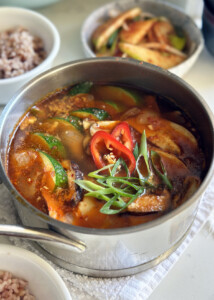
Salads are refreshing. Sushi can be refreshing. In Korea, soup is also refreshing. The word is shyun-hae. It's a hard sensation to describe, how a steaming bowl of boiling hot clear broth can be refreshing, but it is. And there might be a little to do with the fact that the heat from the steam causes us to sweat, which alone is a cooling effect on the body. In fact,sahm-gyae-tahng, a chicken and ginseng soup, is popular during the summer for Koreans. Of course, all those Korean bahn-chan are perfect in summer, since most of them are cold, and spicy.
Sahm-gyae-tahng is a clear broth chicken soup with whole baby or very young chickens. Mom is making this often now, since sahm-gyae-tahng has "medicinal" properties, and is great for pregnant women (no, not me!). It's the protein from the chicken meat, the minerals from the chicken bones, and most importantly, the "medicine" from the ginseng. I don't know what the medicine is, but like all Korean moms, my Mom always tells me "that's what they say." They who?
The chickens are stuffed with washed but raw sweet rice which will eventually "steam" within the bird, dates, garlic, and ginseng. The dates aren't the familiar dark, purplish-brown, wrinkled oblong dates from the Middle East and California. Korean dates are red, fat, and round, and are not as sticky sweet. As the dates cook in the broth, fruit flesh inside softens to a sweet paste, and the date becomes like a little red candy truffle. They are called jujubes, which always make me wonder if the inventor of the jujubees, the movie candy, was Korean - LOL! I will venture a guess that the dates have some sort of fiber benefit, which adds to the "medicinal-ness" of the sahm-gyae-tahng.
I doubt that when sahm-gyae-tahng was first made centuries ago in the countryside, the Koreans knew about antioxidants and the like - they just knew that there was something good about garlic and ginseng. Koreans love garlic, and according to the largest garlic farmer in California (up there in Gilroy, but can't remember his name), his biggest consumers are Koreans! That explains why I love garlic, I guess, but I cannot stand ginseng, even if it relieves fatigue, helps with depression, and fights anemia and diabetes. Ginseng, not to be confused with ginger, tastes like mud.
Young chicken meat is already tender, but the soup is still simmered for a very long time at low heat until the meat falls off the bones and the entire bird basically bursts open with the cooked sweet rice that has now expanded to about three times its volume. Mom is a busy lady these days in her garden and on the golf course, so she shortens the cooking time by doing it all in a pressure cooker. Smart lady.
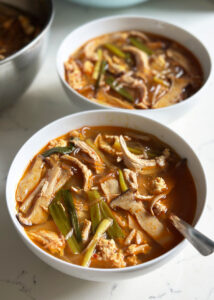
Everyone gets their own whole chicken in their bowl along with some of the rice, dates, and ginseng. The soup is now basically a fragrant chicken broth, but with absolutely no seasoning. Salt, pepper and sesame seeds are served on the table so each person can season the soup to taste. I also dip the chicken meat in the salt and pepper, like tong-dahk.
Mom probably considers it blasphemy, but I also dipped it in sriracha ;)
Clare Eats says
Thanks for the really informative post! I love Korean food, but it is alittle hard to get in most places here. I have no idea where to start with cooking it!
sarah says
and there aren't that many (good) korean cookbooks out there, either! hopefully, someone will soon write a good one for us!
Fatemeh Khatibloo-McClure says
YUM!
You know, Persians also follow a similar path -- hot tea in the heat of the afternoon causes sweating, and cools the body down quickly.
As for jujubes...did you read my post about Persian New Year? We use dried jujubes on our "altar". They are VERY yum.
Who knew Persian and Korean cultures have so much in common?
Kirk says
Another great post - I really enjoy these - I learn alot, superb!
I'm sure you'll let us know when you find a good English Language Korean Cookbook - I'd buy it in a minute.
hermz says
That sounds really good. And some chong-gak kimchee... my first Korean food. I haven't had that for a while.
sarah says
fatemah - that must be why i love persian food! sheesh, now i think it's about time to make another trip over to shamshiri grill :)
i think there is a pretty decent cookbook called doksuni, but for some reason, i wasn't compelled to buy it when i saw it. i think i was hoping for more food porn in it. hee hee.
garsh, herms, i can't believe your first experience with korean food was chong-gak, and still you liked it! i would think you'd have been turned off forever after that, lol!
LACheesemonger says
Well lets see if my CH usrnm will turn up on a Google search on this blog, and why am I not able to capitalize the name? FYI, I rarely post on CHLA-but a few times a year at best (last was May05 for Royal Star, and see my comments on your VIP-softcore ;0). A couple years ago, russkar (the insufferably arrogant know-it-all Nozawa shrill ;-) ) and I 'disagreed' on 1975 Bordeaux and sushi... and well, my posts got deleted, hehe.
======
Bull Durham (1988)
http://www.imdb.com/title/tt0094812/quotes
Crash Davis: Time out. Why do you get to choose?
Annie Savoy: What?
Crash Davis: Why do you get to choose? I mean, why don't I get to choose, why doesn't he get to choose?
Annie Savoy: Well, actually, nobody on this planet ever really chooses each other. I mean, it's all a question of quantum physics, molecular attraction, and timing. Why, there are laws we don't understand that bring us together and tear us apart. Uh, it's like pheromones. You get three ants together, they can't do dick. You get 300 million of them, they can build a cathedral.
[Crash laughs]
Ebby Calvin LaLoosh: So is somebody going to go to bed with somebody or what?
Annie Savoy: Honey, you are a regular nuclear meltdown. You better cool off. Ha ha, ha ha!
[to Crash]
....
Ebby Calvin LaLoosh: Hey, Annie, what's all this molecule stuff?
===========
Yes indeed, I think all cuisines where the temps and humidity are high, have the same soups/heat sweating concoctions. But lets be realistic, sweating just isn't all that fun; that's what they did before the invention of A/C and private Jacuzzi's in your custom Gulfstream III like Tom Cruise has to romantically jet away from SM Airport and seduce Katie Holmes, LOL. Time for American or Italian classics, ultra-premium IC or gelato.... now that hits the spot!
The tiny, teeny, skinny, recent college grad that used to work at Royal Star; she grew up in HK where all of her family/relatives still live. Recall last summer when we had blistering 100+ temps all the way out to the beach in Sept04. Dry heat I know, but the following week it dropped down into the 90F's, but the humidity bumped up. When I went into ask about the Dim Sum (no luck) and shoot-the-breeze with her, she complained that is was just as hot that week also. But I said: "well you grew up in HK, so you should be used to it!" She said she hates that kind of weather, LOL (my kind of woman ;) ). And just the same her mother would make the more modern version of bird's nest soup- coconut milk, chilled dessert version, as the bird's nest (which when she found out what the composition of the nest actually is, became disgusted by it... what a sissy/wussy modern lady ;) ) is supposed to be good for the skin/complexion as her mother would tell her.
Just check Yahoo weather, and see that all summer long HK averages lower 90's with average nighttime temps in the lower 80's! Who could sleep! Through in intermittent thundershowers everyday for 60%+ humidity, and it makes us Angelenos seem like big time wusses. Dim Sum is designed under/for those conditions--at least the HK version, (centuries older Canton inland dim sum, it is cold during the winter months) along with the ubiquitous restaurant tea. See, Jerome doesn't know everyting about Chinese cuisine, even if he speaks and writes the language ;).
Have to tell you Sarah, you crack me up with your extensive posts. How the hell to you have the time and energy to work and blog everyweek like this!
:bow: :bow: I'm not worthy ;-)
Too hot to post anymore tonight, I'll add a few notes to the Typhoon over the weekend, if you don't mind.
BTW:
"Hey, Sari, what's all this food porn stuff?" ;-)
C(h)ristine says
I found you via a google search for sahm gyae tang....Oh your post is refreshing in itself! I crave everything you write about here--!
acnecare8 says
i love to eat Chicken Soup, my mom used to always serve that dish with me specially when i am sick during my childhood days.
TONY08-28 says
Chơi ở hd streamz app thấy hệ thống phản hồi khá nhanh khi thao tác liên tục. TONY08-28