
Last week, I shared my adventures in making Bibimbap, a colorful Korean rice and veggie bowl that I've been obsessed with, honestly, since I started eating solid food. I didn't post the recipe because to be quite honest, there's no real one single recipe for Bibimbap.
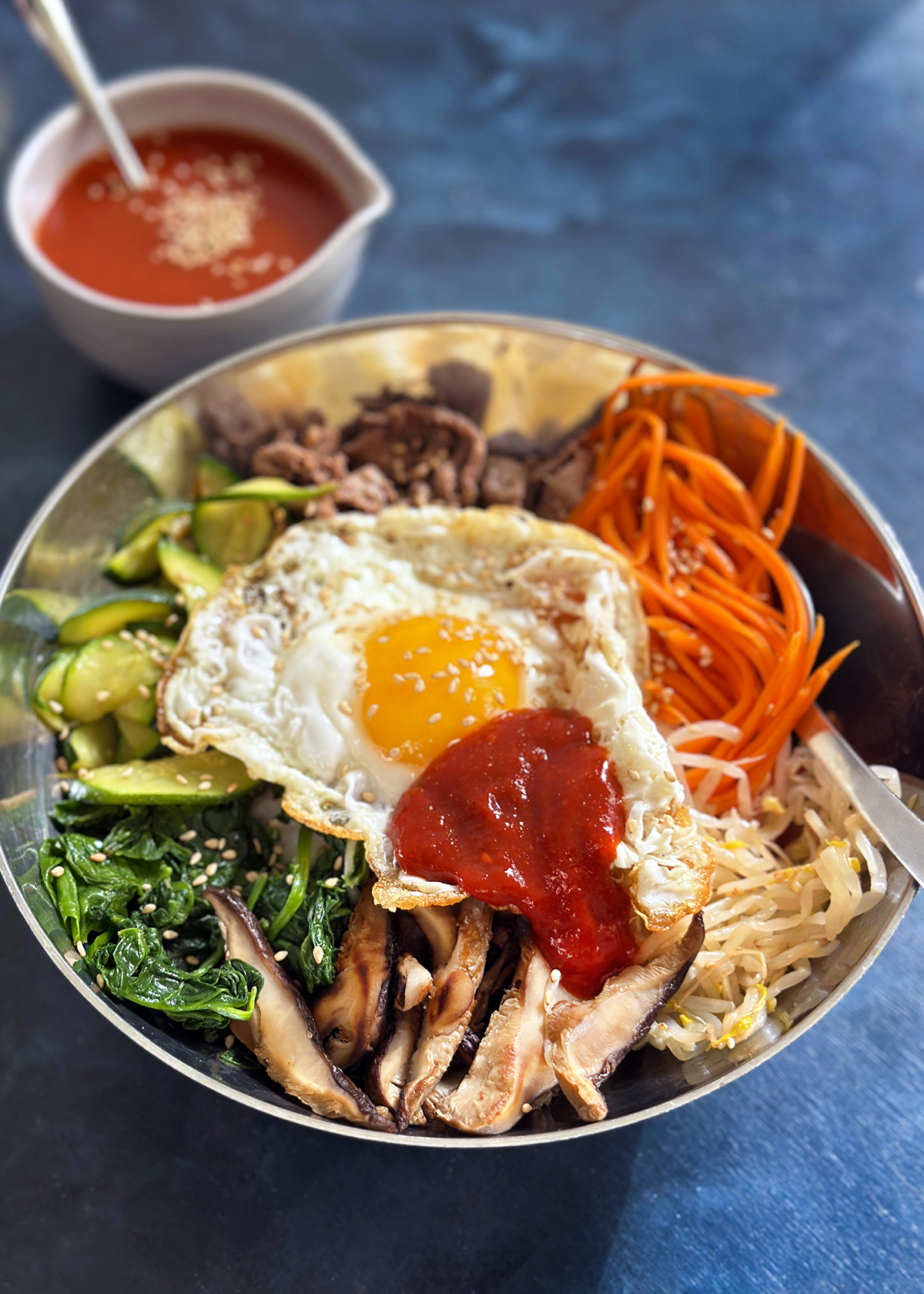
But people have been asking me for a recipe for years, so here's a great recipe and reference for a traditional-ish Korean Bibimbap to get you started, and once you get that down, you can get creative and customize your own Bibimbap adventure! Shall we?
Explore More
So, What Exactly IS Bibimbap?
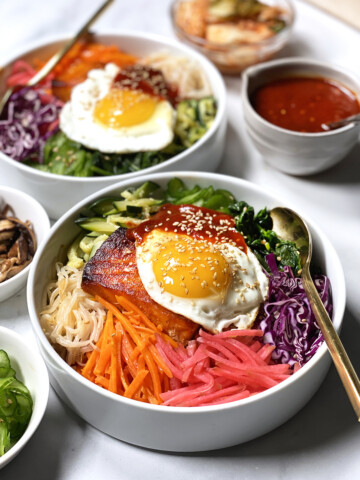
At its core, Bibimbap consists of a bowl of steamed rice topped with a colorful assortment of fresh, pickled, and cooked vegetables, usually some kind of protein like tofu or beef, topped with egg, and hot sauce. All of the components of bibimbap are arranged carefully by color to serve, then mixed together in the bowl right before eating.
"Bibimbap" translates literally from Korean "bibim" + "bap" to English as "mixed" + "rice."
You can consider it the original grain bowl, but Bibimbap isn't just throwing a bunch of rice and any old vegetables in a bowl. The beauty of bibimbap is in how the bowl is put together, balancing a variety of colors and contrasting tastes and textures of the individual ingredients. Each vegetable is prepared separately to enhance its particular flavor. Then, the ingredients are arranged within the bowl with intention.
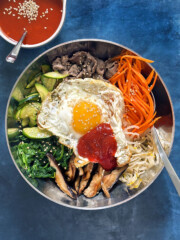
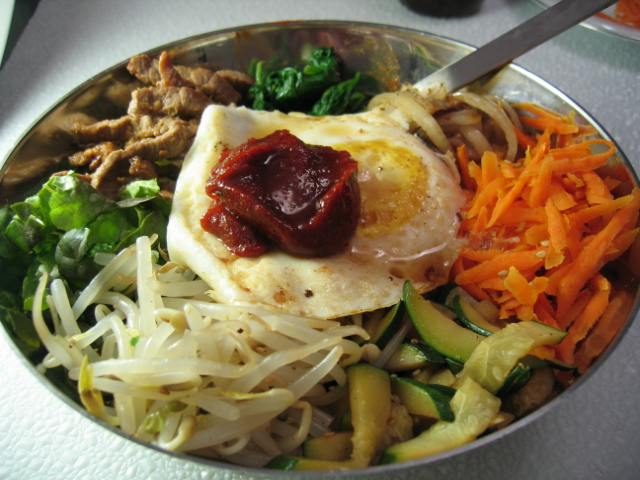
Some of the traditional bibimbap ingredients show how color, taste, and texture come into play: soft, steamed short-grain white rice as the base, sweet orange carrots, crisp yellow bean sprouts, herbal green spinach and zucchini, earthy daikon radish, and umami from sauteed shiitake mushrooms and thinly sliced beef. A bright, sunny yellow egg, and fiery red gochujang round out the bowl.
Traditional vs Modern Variations of Bibimbap
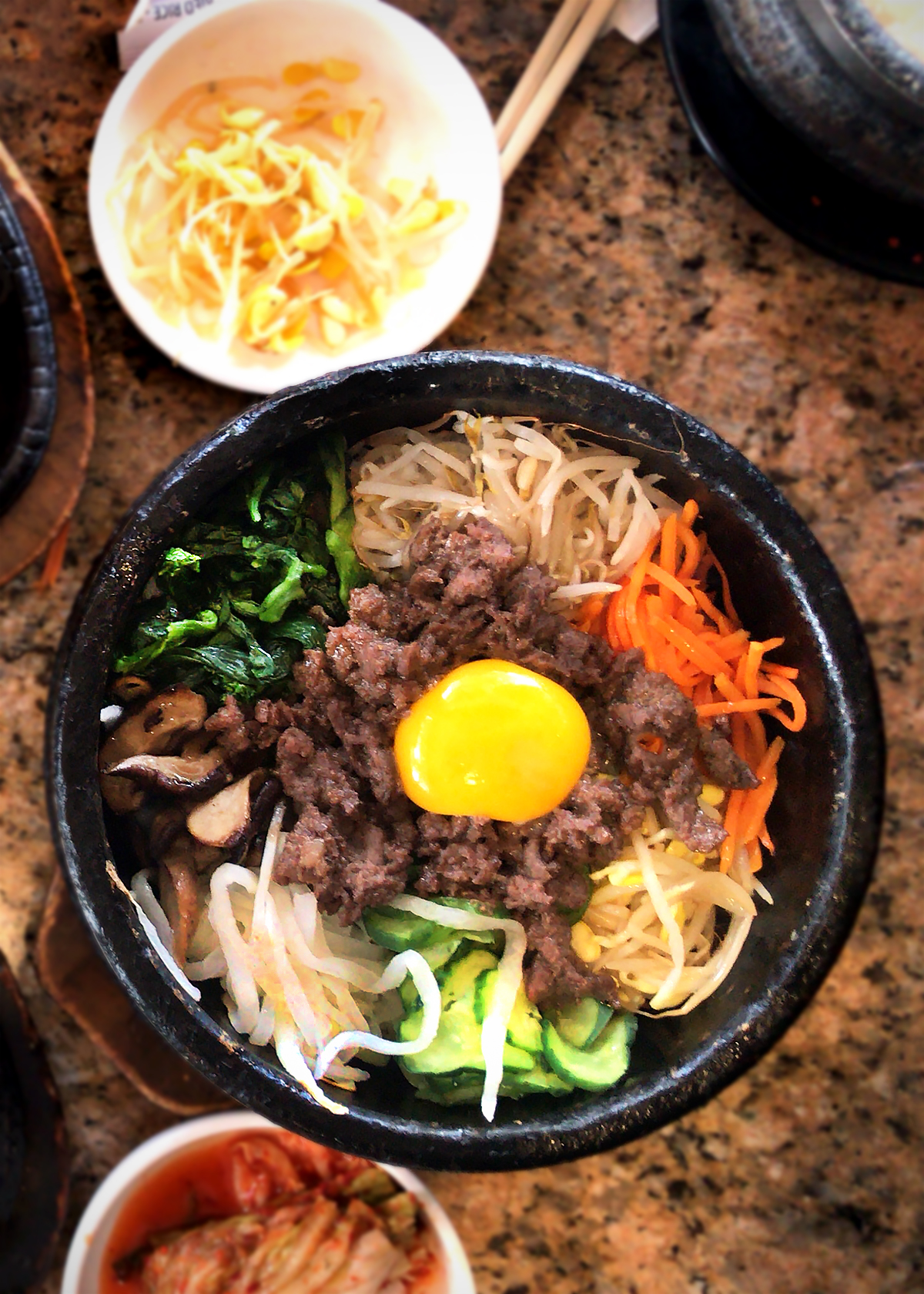
Like kimchi, japchae, and galbi, Bibimbap (비빔밥) belongs to the canon of iconic Korean dishes that are more than just a single recipe. While there's usually one general "traditional" version, the dish represents an entire category of dishes that have variations.
Bibimbap is a perfect example. Not only can the Bibimbap itself have different things in it, but the way each of those things are seasoned/cooked can vary as well. About the only consistent things in Bibimbap are the bap (steamed rice) and gochujang-based bibimbap Sauce. Hell, I even take the rice out of mine and used crumbled tofu as the base when I'm "'protein-maxxing!"
There are some common variations like Dolsot Bibimbap, which is served sizzling in a hot stone bowl, and Hwe Dup Bap, a seafood version that features sashimi-style raw fish as the protein. But really, the variations are endless when you take into account local regions, seasons, and personal taste preferences.
Way Backstory Time!
Bibimbap dates back to at least the 16th century , commonly served at Buddhist temples in Korea. At the time, meat was considered a luxury, so bibimbap often included just vegetables and rice. As a plant-forward eater, all-vegetables is how I most often prepare my bibimbap, even when others at the table with me have beef or chicken mixed into their bowls.
Each of the bibim-bahp ingredients can be made in uber-excess, because in essence, they are all different kinds of bahn-chan. Whatever is leftover from bibim-bahp can be served again with another Korean meal. Actually, the way it would normally play out is that you have a Korean barbecue feast, and the next day, you make bibimbahp with all the leftovers :) So these are each of the guidelines for the individual items - guidelines, not recipes, because everything should be adjusted to personal taste.
The funny thing with Korean food is that it's very difficult to nail down a single definitive recipe. There's a basic recipe for one thing, for example, ricotta gnocchi (which I will be attempting this weekend), but it will taste different in every household because it has been adjusted to the cook's taste, even after many a hand-me-down from generation to generation. Now that I think about it, this is pretty much true for any food. Baking, not as much. But cooking, totally.
What Ingredients You Need for Traditional Bibimbap
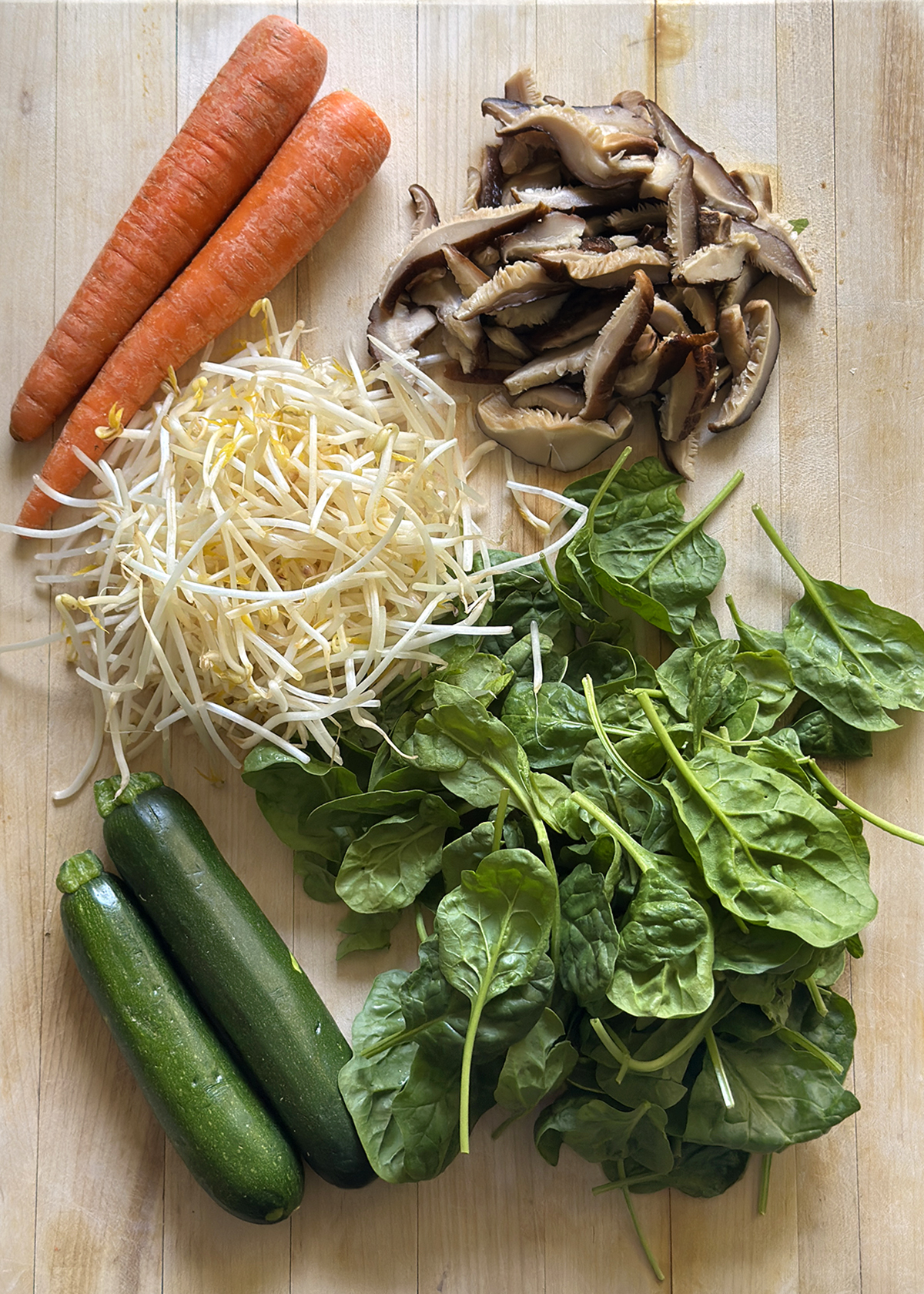
For 4 servings of the Bibimbap (easily ratio-ed up or down):
Fresh/refrigerator ingredients:
- Beef ribeye, 8 ounces, sliced paper-thin
- Garlic, 2 cloves finely minced
- Ginger, ½ teaspoon fresh grated
- Bean sprouts, 4 cups
- Carrots, 2 julienned
- Spinach, 10 ounces
- Zucchini, 2 large julienned
- Shiitake mushrooms, 2 cups sliced caps
- Eggs, 4
Literally, substitute in any other fresh, cooked, or leftover vegetables you love and/or are in season. In fact, bibimbap is a GREAT way to finish any and all the vegetables you need to use up in your refrigerator. Broccoli? Chop, drop and season. Kale? Cook it like the spinach. Sweet potatoes? Julienne and cook them like carrots. The one thing to keep in mind is to go for a variety of color, and a mix of fresh/raw, pickled, and cooked.
Dry/pantry ingredients:
- short-grain rice, 1¼ cup raw, or 3-4 cups cooked
- soy sauce, 1 tablespoon
- maple syrup optional for added sweetness for the beef
- avocado oil, 3 tablespoons + 2 teaspoons or other neutral oil for cooking
- sea salt, 2½ teaspoons plus more to taste
- sesame oil, 4 teaspoons
- roasted sesame seeds, 1½ tablespoons
For the Spicy Bibimbap Sauce:
- 4 tablespoons gochujang
- 2 tablespoons rice vinegar
- 2 tablespoons toasted sesame oil
- 1 teaspoon maple syrup plus more to taste
- 1 clove garlic grated
Ingredients Notes, Resources, and Substitutions
Here are the ingredients, generally in order of preparation, starting with the beef because it requires marinating time, and ending with the spicy Bibimbap Sauce, which you can whisk together in about 5 seconds.

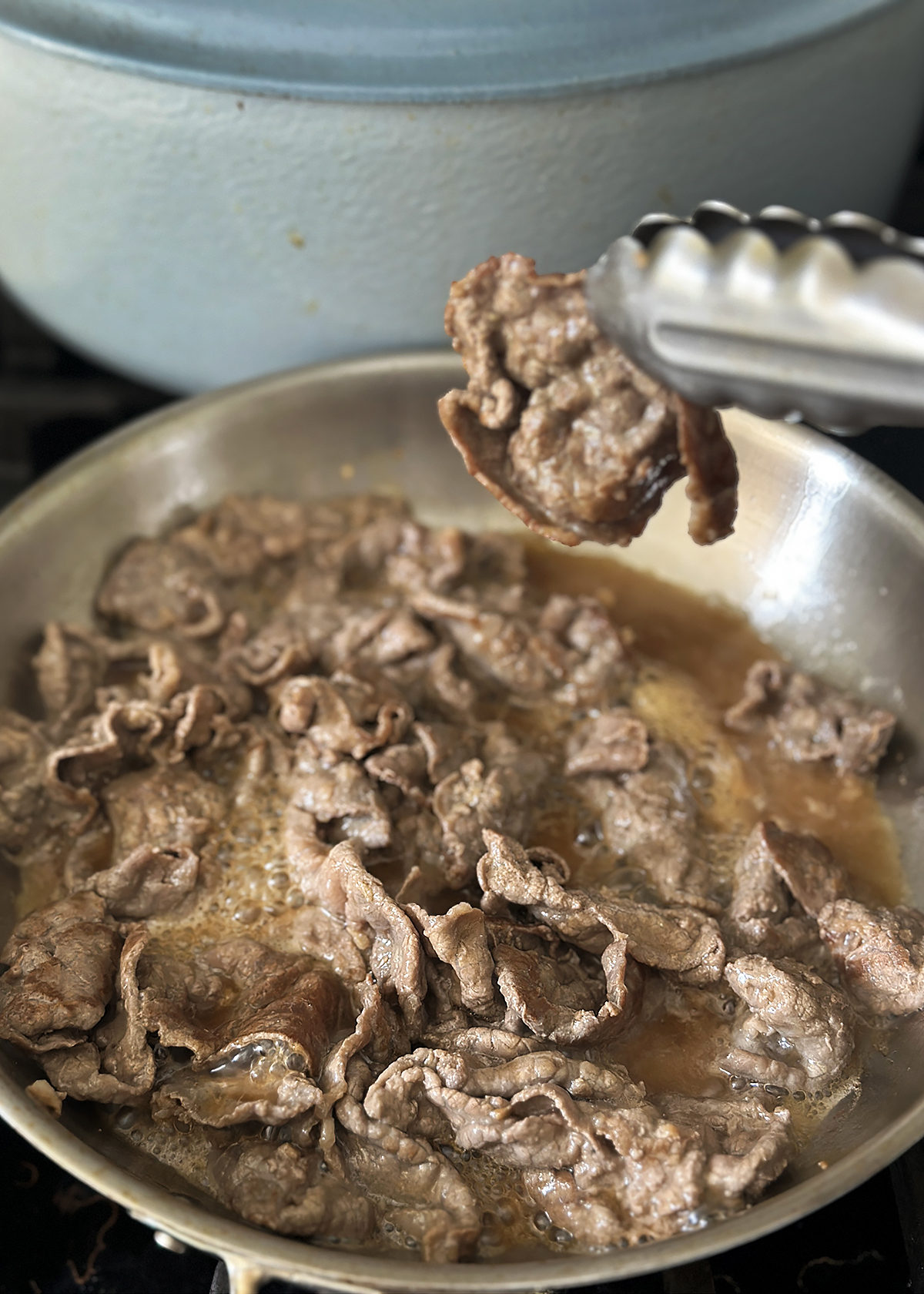
Marinated Beef
The marinade can be used for bulgogi and galbi as well. Many cooks add tenderizers to the marinade for galbi, but we don't need that here because the meat is sliced super thin for Bibimbap. I've seen friends' moms use Coke, crushed pineapple, or kiwi, all of which adds sugar. It's the acid that tenderizes the meat (and wears away the enamel on your teeth!).
The sugar factor is something to note. The recipe below includes maple syrup as an optional sweetener because my family typically veers away from extra sweetness, so the beef may not be as sweet at what others like or are accustomed to in the restaurants. Like everything, that can be adjusted with more sweetener.
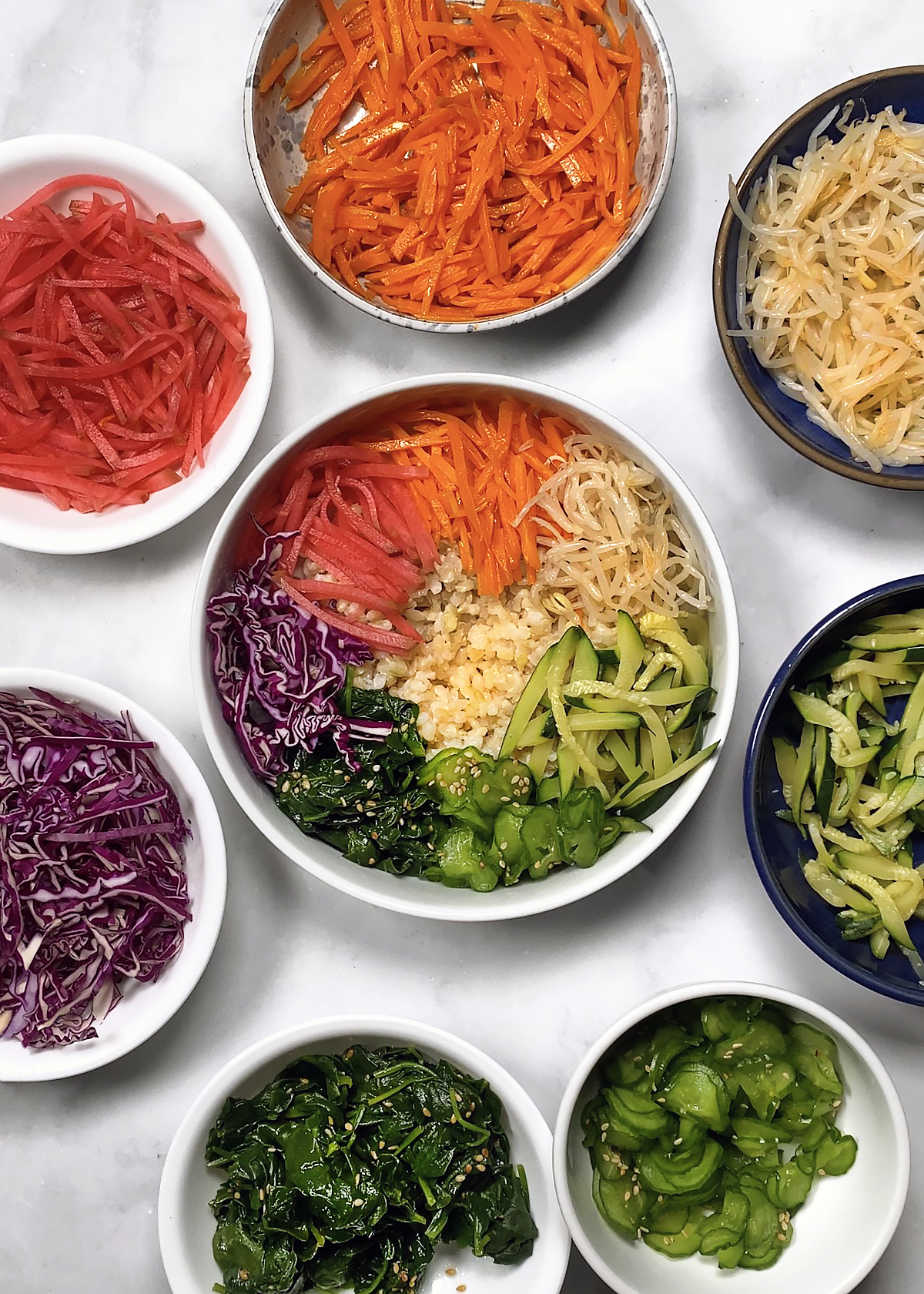
Bibimbap Vegetables
Though vegetables for bibimbap are open to your personal taste and what's in season, there is some method to the delicious madness. Traditional Bibimbap incorporates vegetables that balance taste, texture, and color. So, the key is to select a combination of 3-5 vegetables that vary in color and prepare them in a way that vary taste and texture.
There are a few vegetables that are more common for traditional versions. Carrots, spinach, zucchini, and mung bean sprouts or soybean sprouts (whichever you can find) are almost always included. Seasoned radish, lightly pickled cucumber, and even shredded lettuce can make an appearance. I include shiitake mushrooms because I like to slip those healthy little f**kers in wherever I can.
One traditional Korean vegetable that's noticeably absent from this recipe, however, is fernbracken, aka gosari, or 고사리. They are the thin, somewhat fibrous and chewy dark purplish brown stems of a type of fern in the same family as fiddlehead ferns. Fernbracken are known to be toxic to livestock and have been shown to be carcinogenic (cancer-causing) to humans. Like all things, a small amount is probably ok, but why tempt fate? I personally don't find the taste to be worth the risk.
Whatever vegetables you end up choosing, prep the vegetables into the thinnest or smallest pieces so that it's easy to mix everything together eat with a spoon.
Egg
The most traditional bibimbap includes just an egg yolk on top, and it's completely raw straight from the shell (or "straight from hell" because I personally hate raw eggs in anything). However, the raw egg yolk has evolved over time/taste into a whole fried egg, with that sunny, runny egg yolk. The egg yolk mixes with the Bibimbap sauce to add texture and helps all the ingredients stick together.
My weirdly particular, personal taste is for a fully cooked egg, so since each egg is essentially cooked to order just before serving on top of each bowl, I always cook mine over hard, even if everyone else's at the table are sunny-side-up. But you do whatever you do, this is your Bibimbap rodeo.
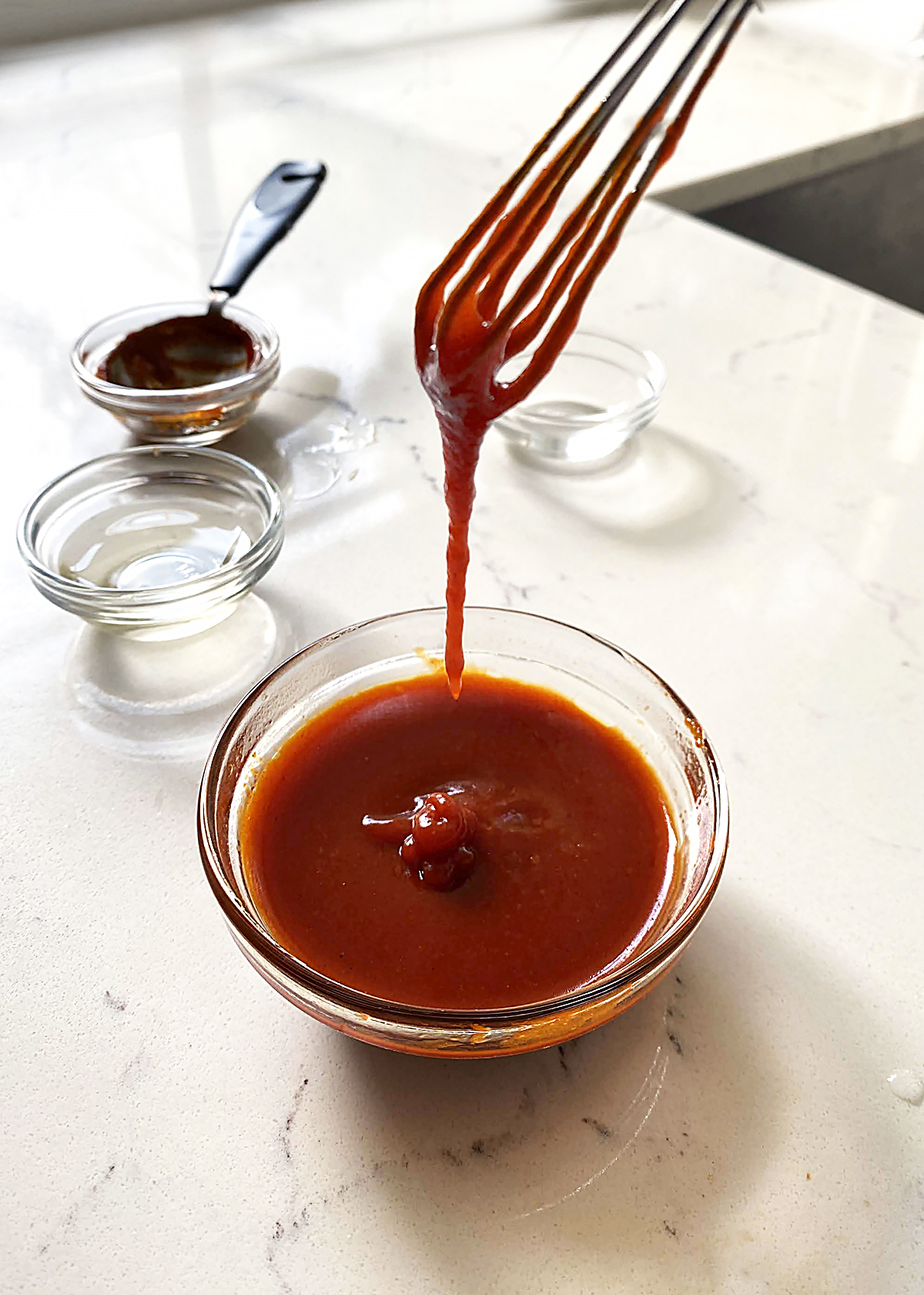
Bibimbap Sauce
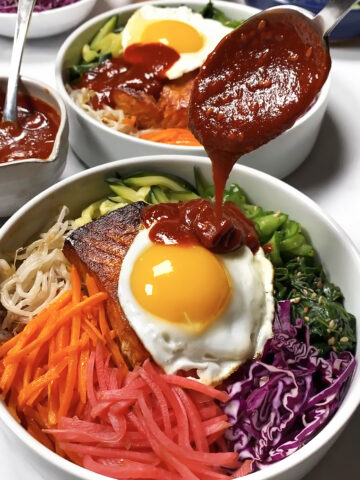
The sauce! The Bibimbap Sauce! Without the spicy, gochujang based Bibimbap sauce, you just have a regular shmegular ol' grain bowl. Serve it alongside the bowls so you can amp the heat level to your liking.
A quick note, this recipe has less sugar than a lot of other recipes, and definitely less than everything I've ever tasted out at a restaurant (too sweet!). If you like it sweeter, just add more maple syrup, honey, or sugar to the sauce.
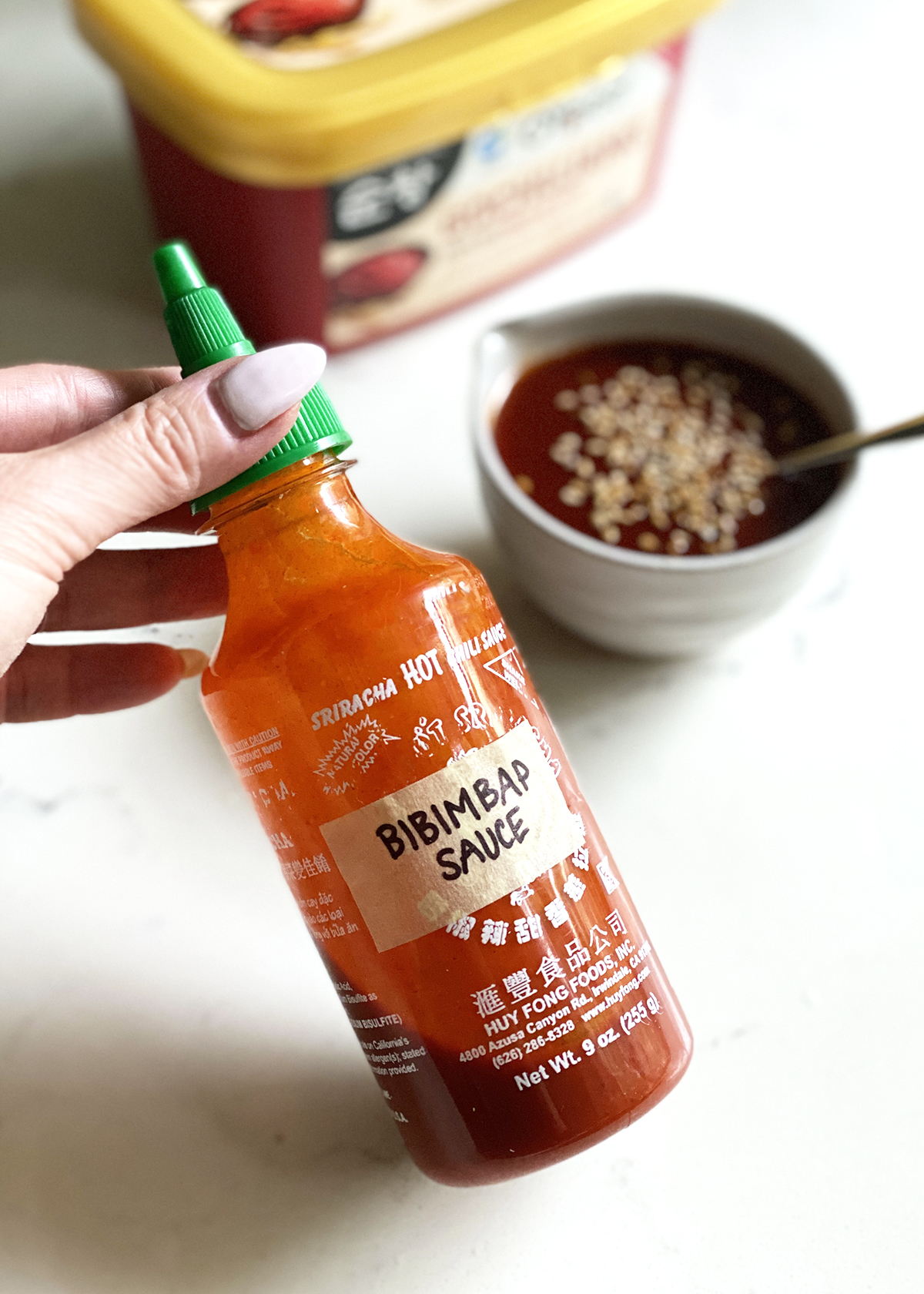
Pro-tip: Make double, triple, or even quadruple the Bibimbap Sauce in the recipe. Guaranteed that you will want to keep adding more to your Bibimbap bowl as you eat, and it works great as an all-purpose hot sauce that you can keep in your refrigerator for to a week. I put the leftovers in a cleaned out sriracha squeeze bottle!
Rice
You can't have bibimbap without the "bap," which is rice in Korean.
Rice used for Traditional Bibimbap is almost always short-grain white rice. And if you have had rice in a Korean restaurant, you know that it's always super glossy. I have been brainwashed into believing that they way to achieve that shine is by washing rice until your rinse water runs clear.
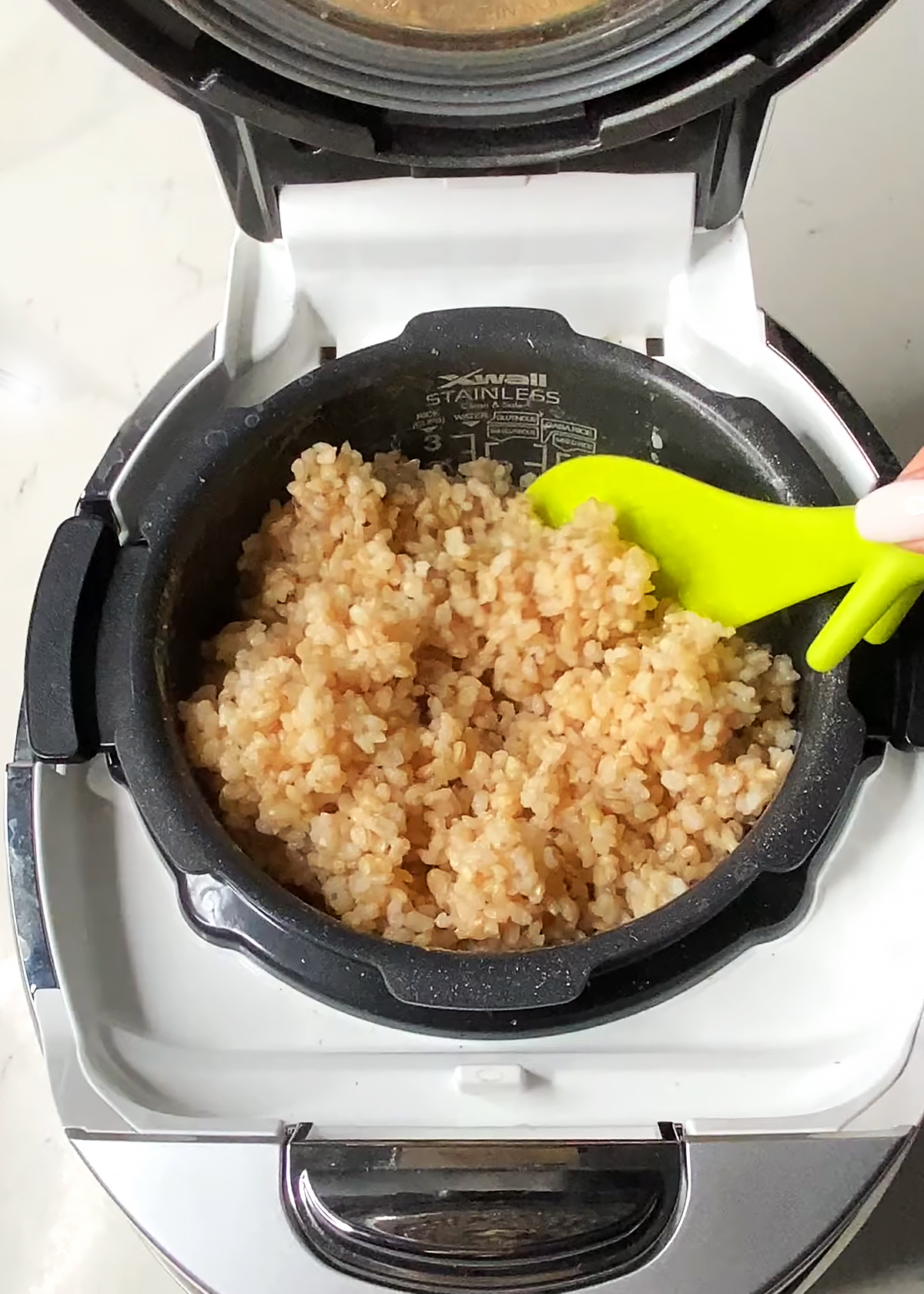
In my home kitchen, I use a short- or medium-grain brown rice for the fiber boost. If you have access to a Japanese grocery store, look for rice from Koda Farms, which is a multi-generational Japanese rice farming family in California who grows the best rice.
And if you really want to go the gut-healthy fiber distance, you can use Korean-style purple rice, which is a non-specific combination of grains that can include but is not limited to white or brow rice, black rice, which is what gives it the purple color, other grains like barley or amaranth, and any variety of beans.
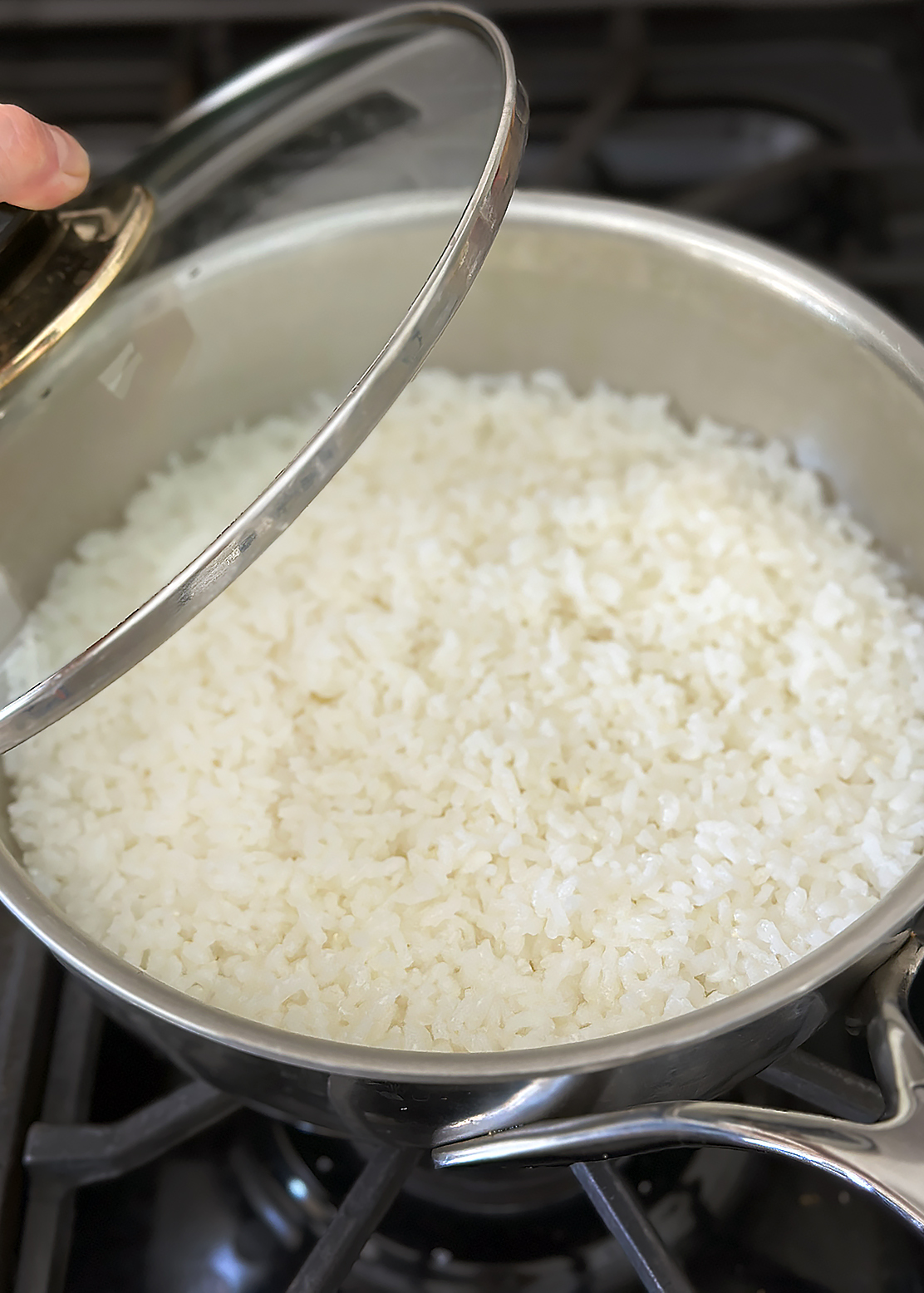
Pro-tip: Slightly drier rice make for better bibibmap because all the additional ingredients can add moisture, especially the gochujang-based Bibimbap Sauce. Rice cookers these days are pretty good about cooking rice "perfectly" even if you add slightly more or less water, but if you cook rice on the stovetop, let it cook a little longer, or let it "dry out" after it's done cooking by leaving the lid off for the steam to blow off.
How to Serve Traditional Bibimbap
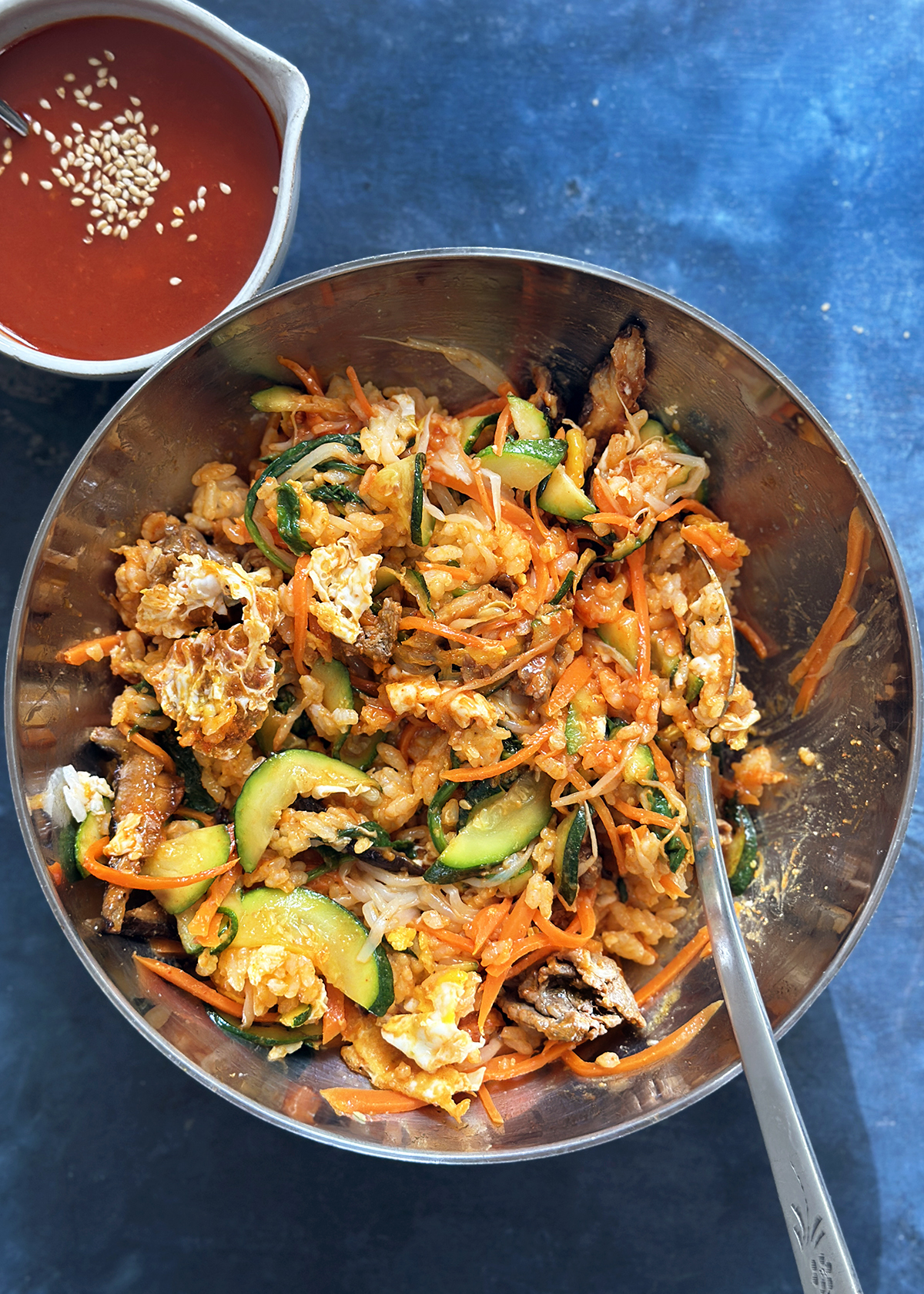
Place a single serving of rice ~ ½ to ¾ cup steamed white rice in a large bowl. Place each of the vegetables and the bulgogi around the bowl; egg goes in the middle. It can also be garnished with julienned gim (toasted seaweed/nori). A drizzle with a little sesame oil on top is also a nice touch. Each person adds the Bibimbap Sauce to his or her own taste, then mixes the dickens out of everything in the bowl.
So there it is. Bibimbap. Seems complicated because it's long, but it's really quite simple, though it does end up using tons of pots, pans, utensils, etc. All worth it in the end though...and that's what dishwashers are for, anyway.
Step-by-Step Instructions for How to Make Bibimbap
I know. It looks like a lot of steps. But each one is actually pretty quick and it's all worth it in the end.
Make Rice. Rinse 2 cups rice under running cold water until water runs clear, about 4 or 5 times, then steam in rice cooker as per manufacturer's instructions, or cook on stovetop.
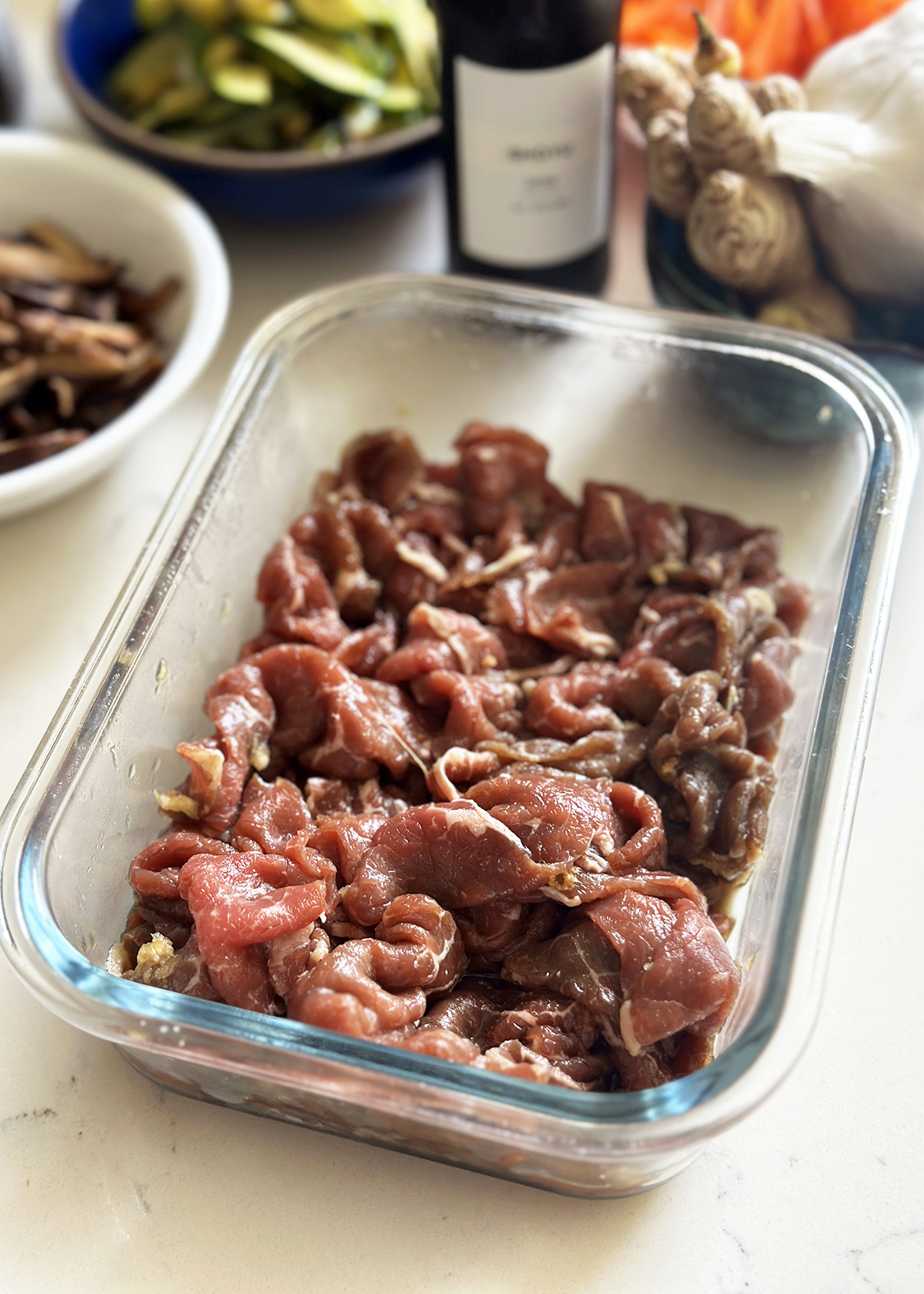
Marinate Beef. Combine minced garlic, grated ginger, 2 tablespoons soy sauce, and optional 1 tablespoon maple syrup if using in a medium bowl. Add sliced beef, stir until beef slices are well coated with marinade on all sides. Using your clean hands to gently massage the marinade into the meat doesn't hurt! Cover and set aside for 30-45 minutes while rice cooks and you prep the remaining vegetables.
Make Sauce and Prep Vegetables for Bibimbap
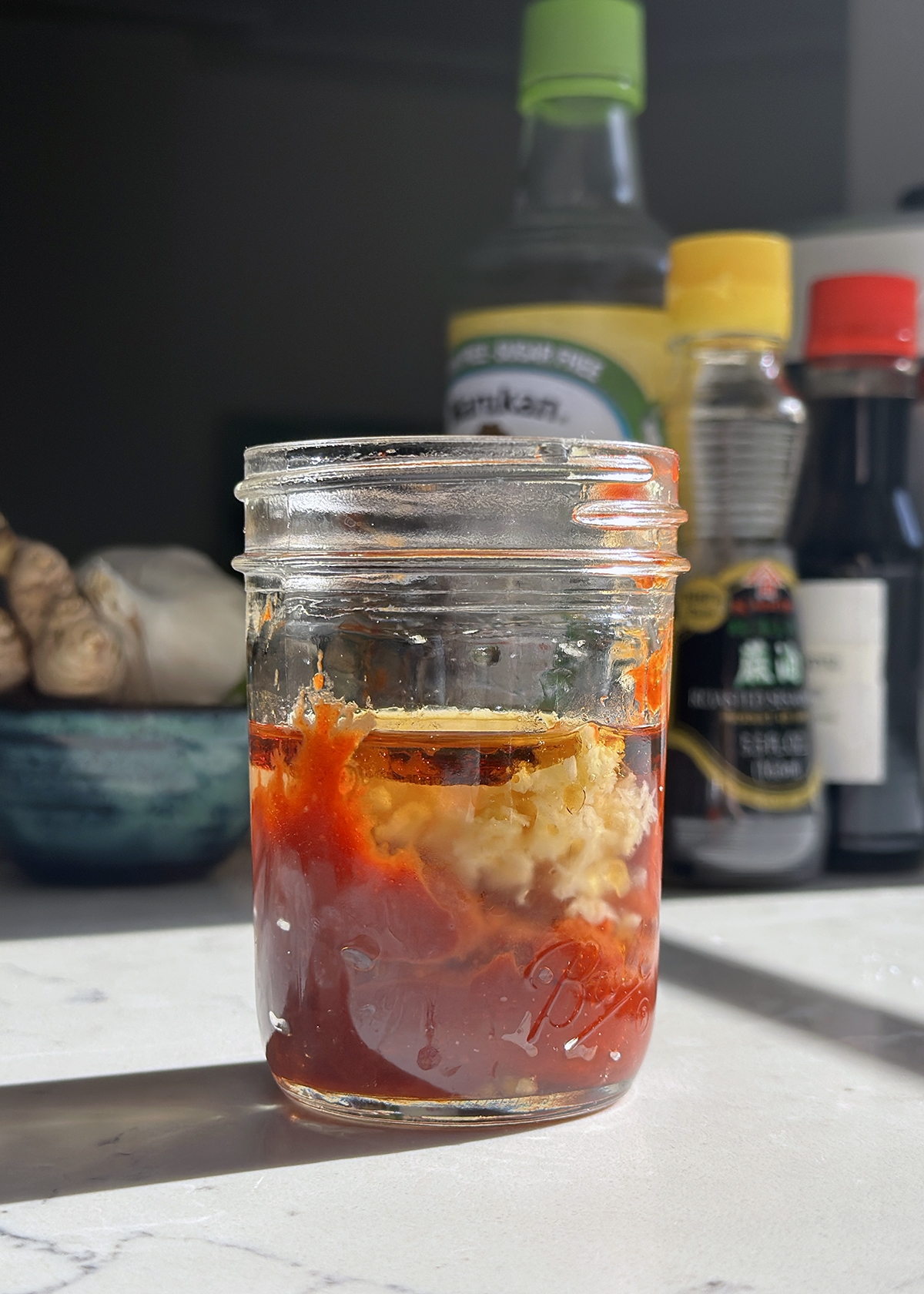
Combine all ingredients for the bibimbap sauce together in a small bowl or jar. Use immediately and store leftovers in an airtight container in the refrigerator to use on demand.
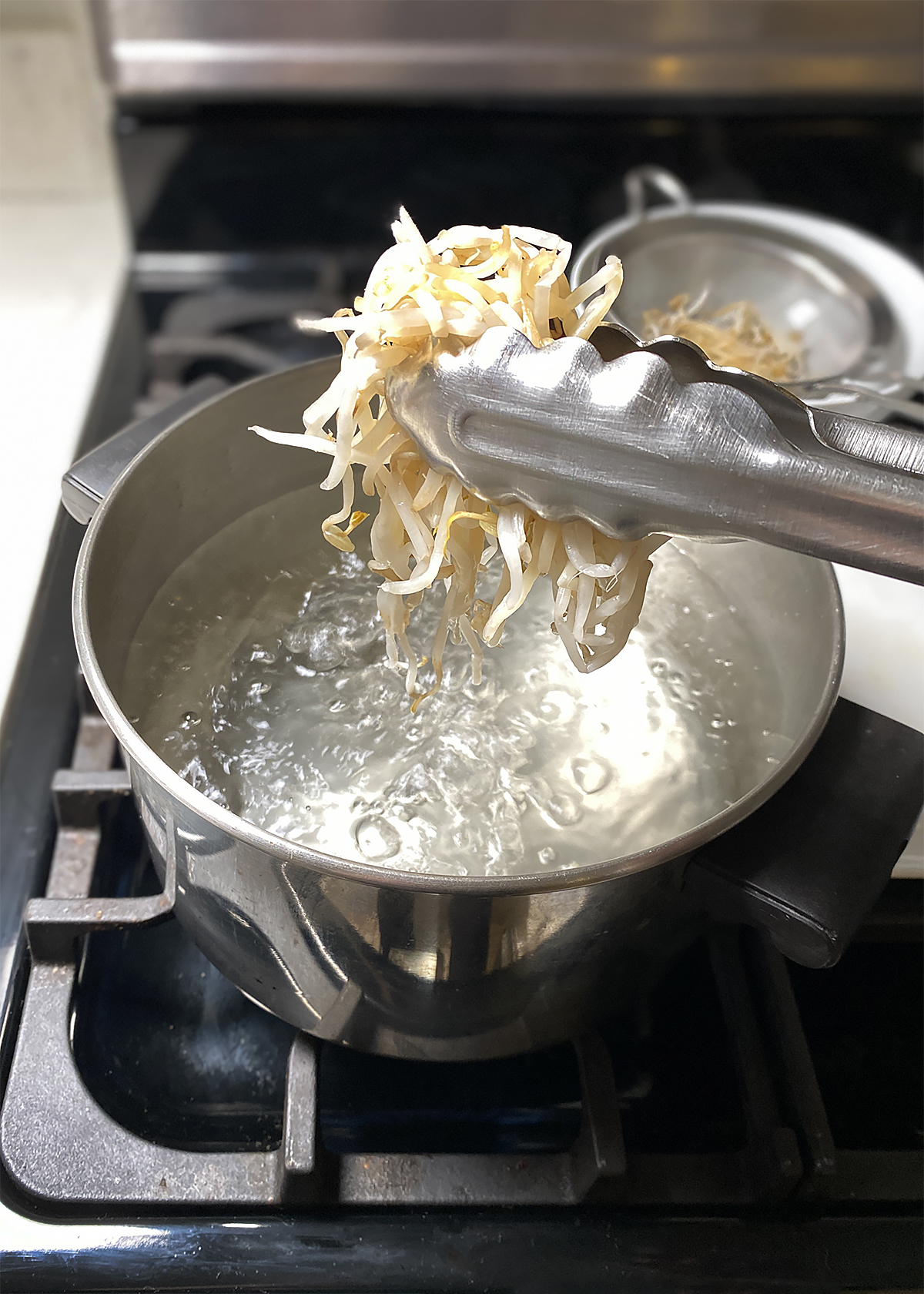
Bring a large pot of water to boil.
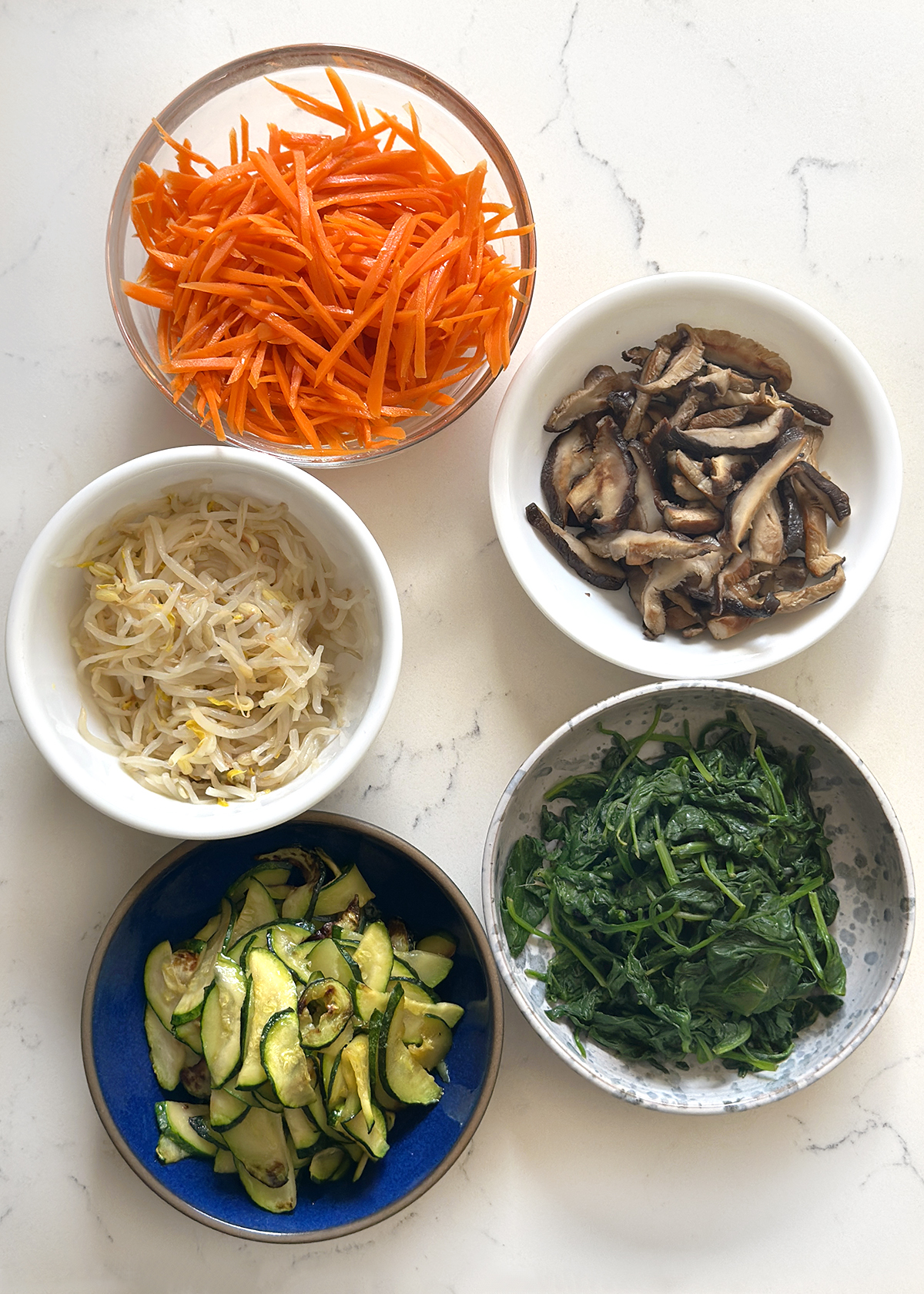
Drop bean sprouts into boiling water. Return water to a boil, then turn down to a simmer. Blanch the sprouts until they are just beginning to wilt, about 10 minutes. Remove the sprouts from the pot with tongs, large slotted spoon, or small colander, leaving the water in the pot. Drain off or squeeze as much water from the sprouts as possible. Toss with ½ teaspoon salt and 1 teaspoon sesame oil. Set aside.
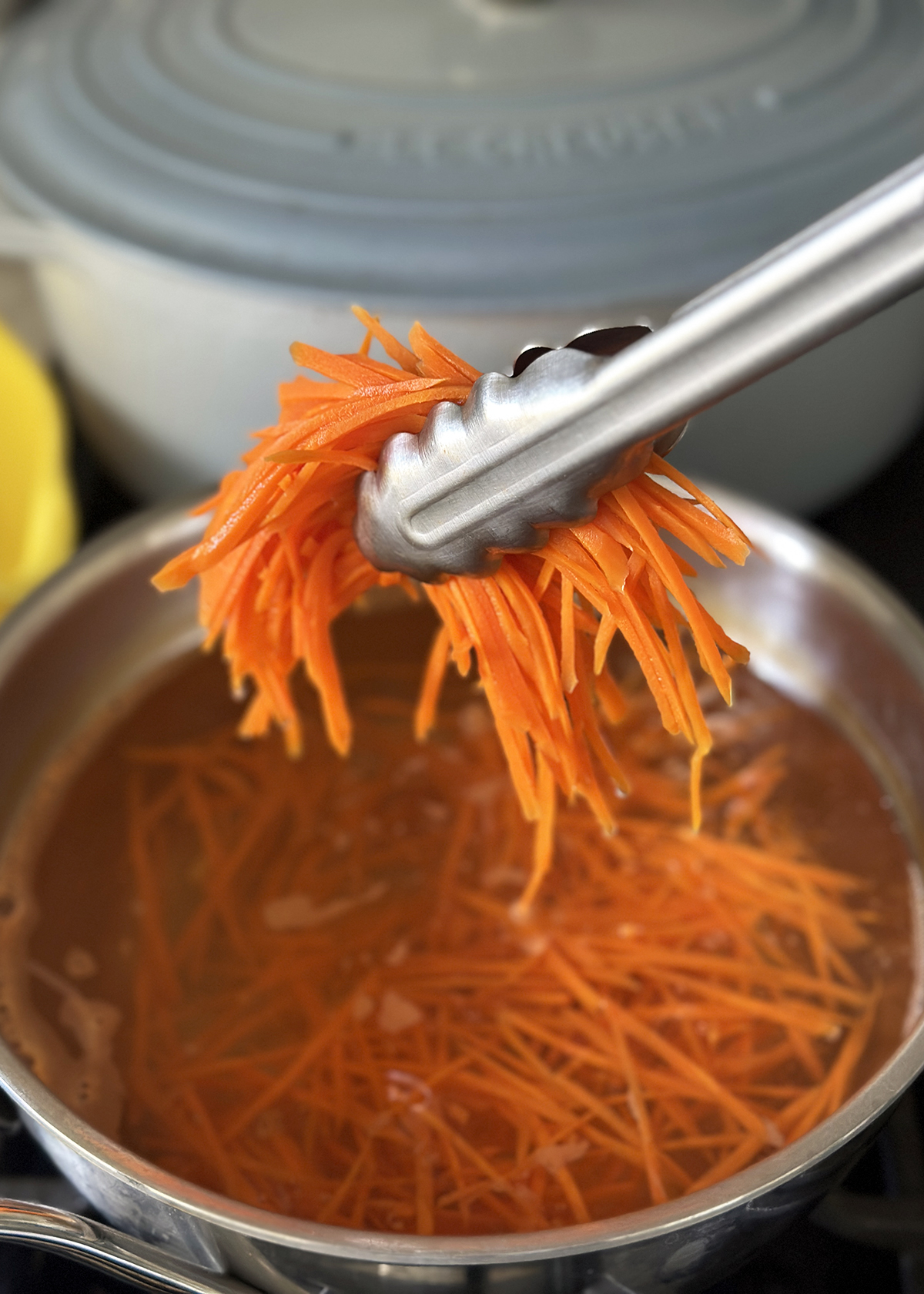
Continue the same method of drop-blanch-remove-drain for the julienned carrots. Carrots will take about 10 minutes to soften. Toss with sesame oil and ½ teaspoon salt and ½ teaspoon sesame oil.
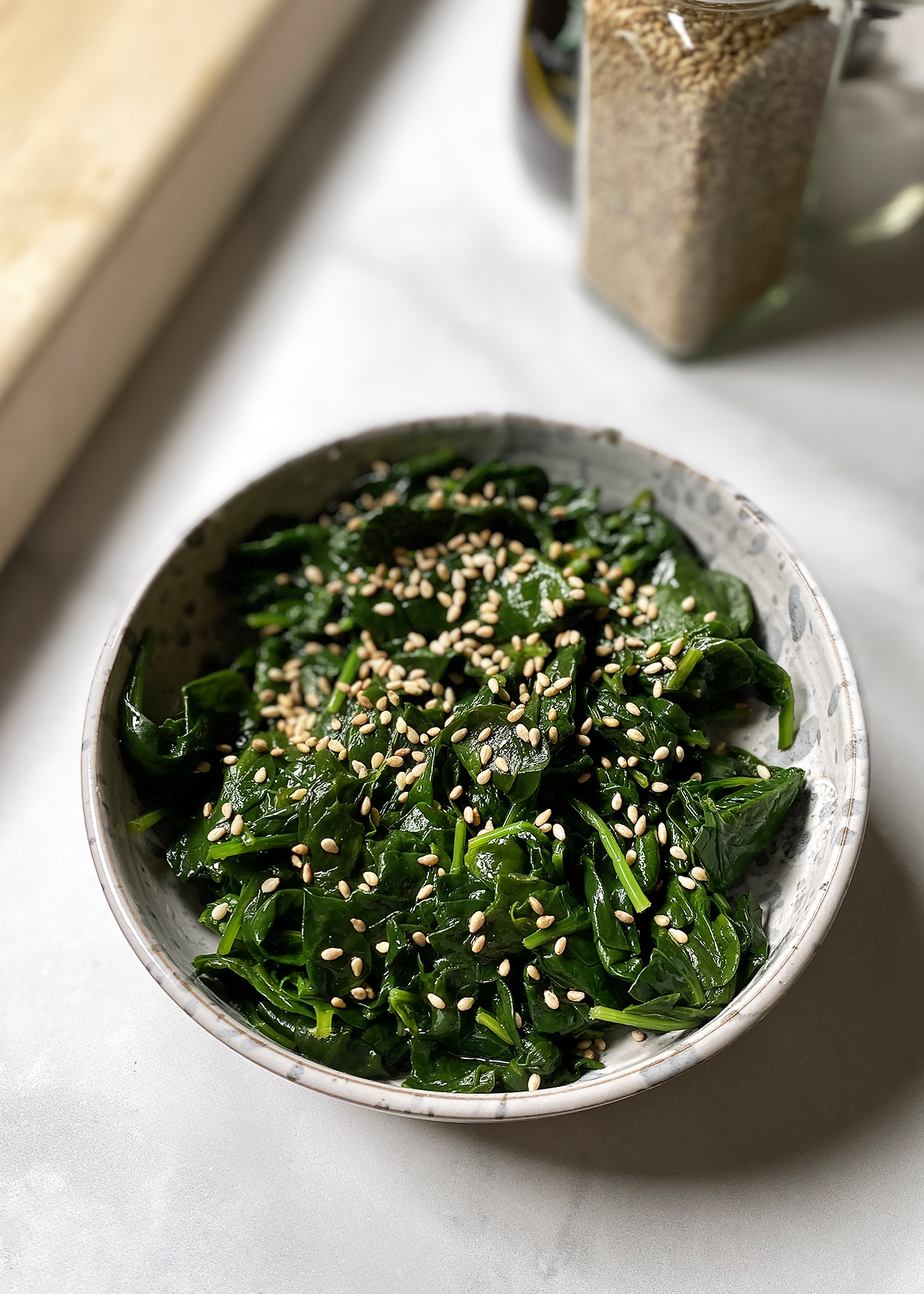
Repeat process for spinach, which will blanch in about 3 minutes. Toss with Toss with ½ teaspoon salt and 1 teaspoon sesame oil.
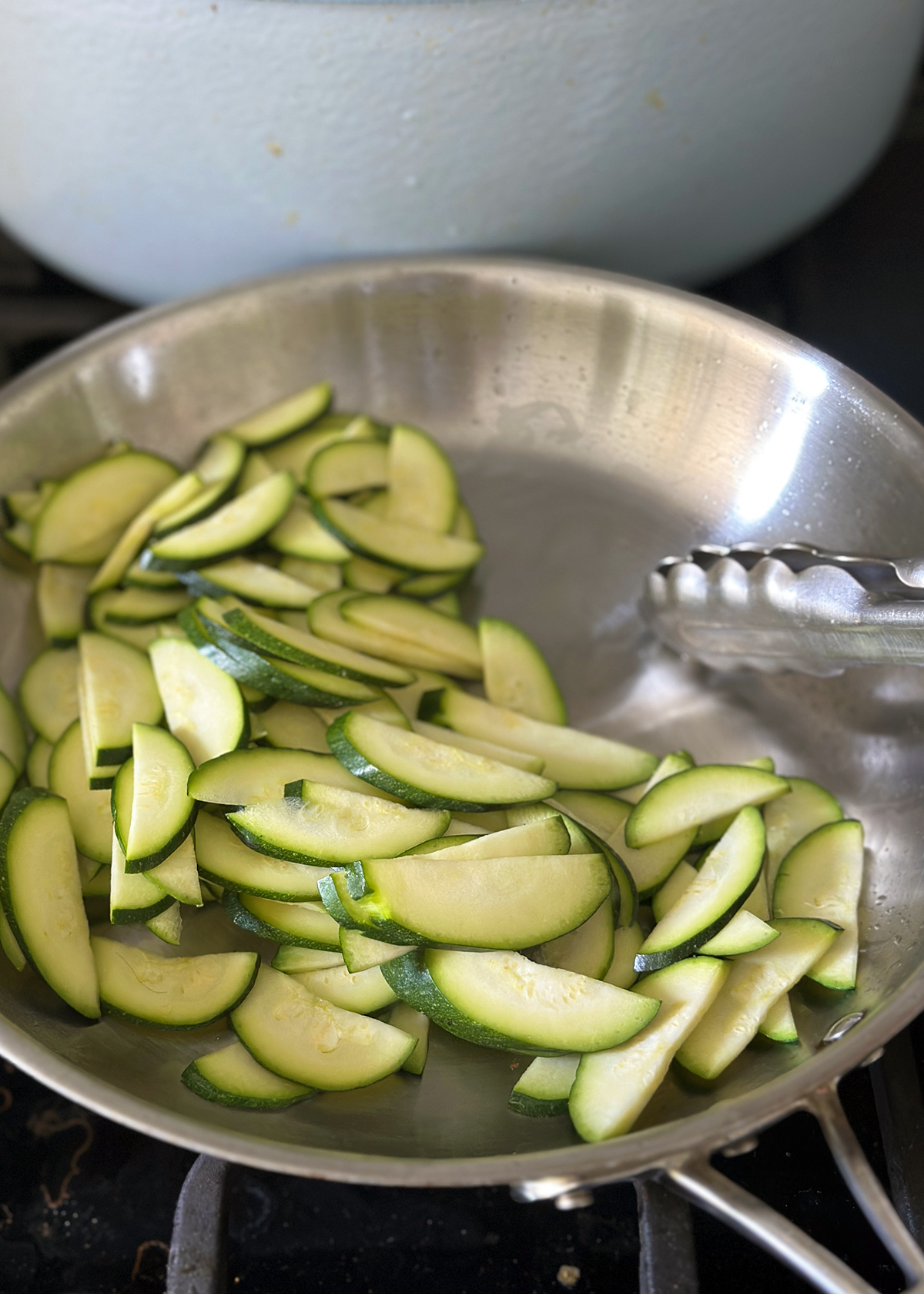
While you're waiting for the water to boil for the bean sprouts, carrots, and spinach, heat 2 teaspoons neutral cooking oil in a large skillet over medium high heat. Add zucchini to the pan and sprinkle with ½ teaspoon salt. Sauté until just the zucchini is barely beginning to soften and most of the rendered liquid has evaporated off. Remove to a small bowl. Toss with 1 teaspoon sesame oil and set aside.

Add 1 tablespoon oil to the pan and swirl to coat the bottom evenly. Add the sliced shiitake mushrooms, sprinkle with ½ teaspoon salt, and sauté until mushrooms have cooked through and are starting to very lightly char at the edges. Remove from pan and set aside.
Cook Eggs and Marinated Beef
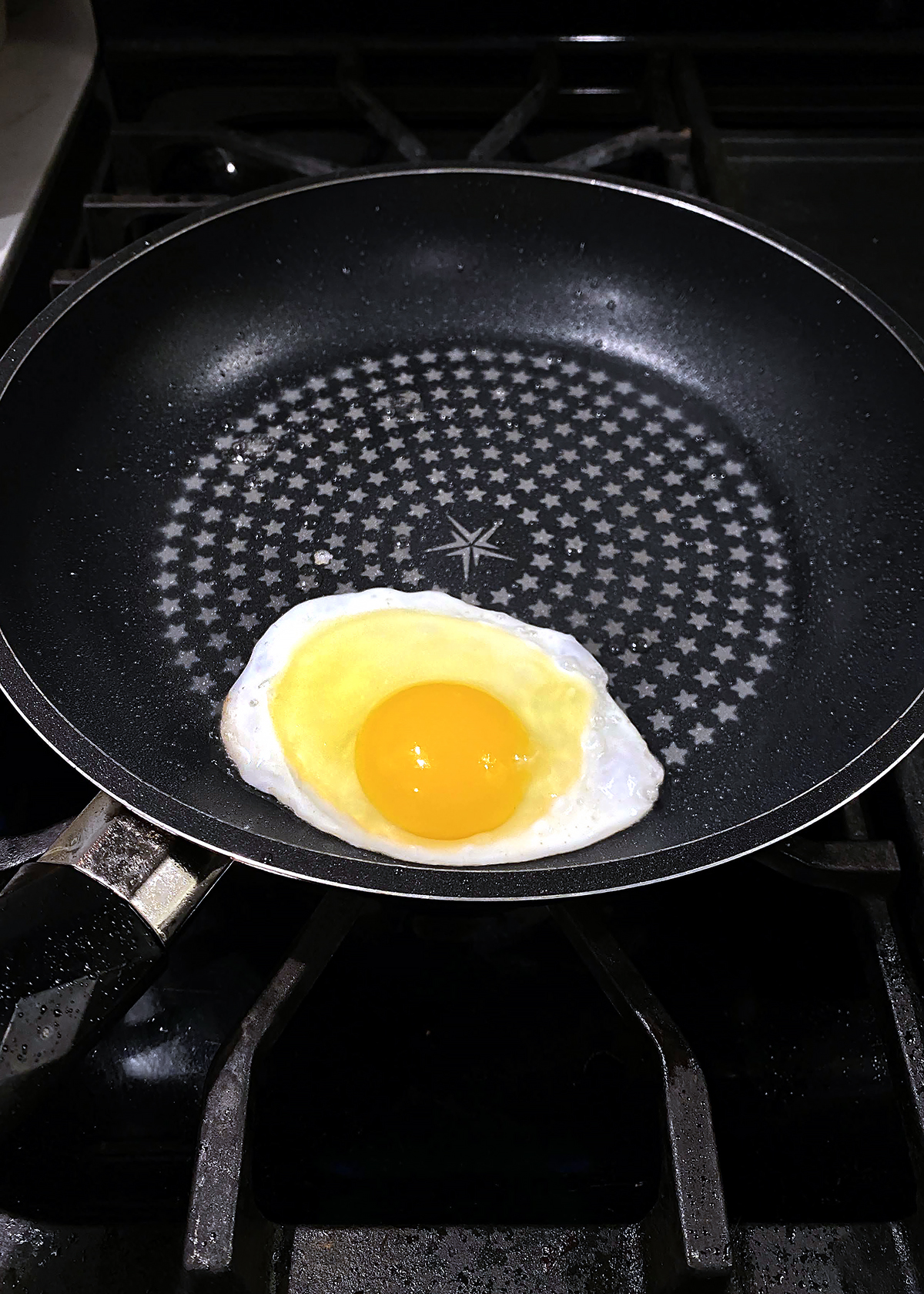
Turn down heat to medium low, add 1 tablespoon oil to the pan. Fry eggs sunny side up. (I personally cook my eggs over-hard. Sorry not sorry!) Remove eggs from pan to a plate and set aside.
Wipe out the pan to remove any errant burnt or crisped veggie or egg bits. Heat 1 tablespoon oil in frying pan over medium-high heat, then add marinated beef. Sauté until just cooked through, about 5 minutes. Total cooking time depends on how thick the beef slices are. Remove cooked beef from pan and set aside on a plate to cool.
Assemble Bibimbap Bowls
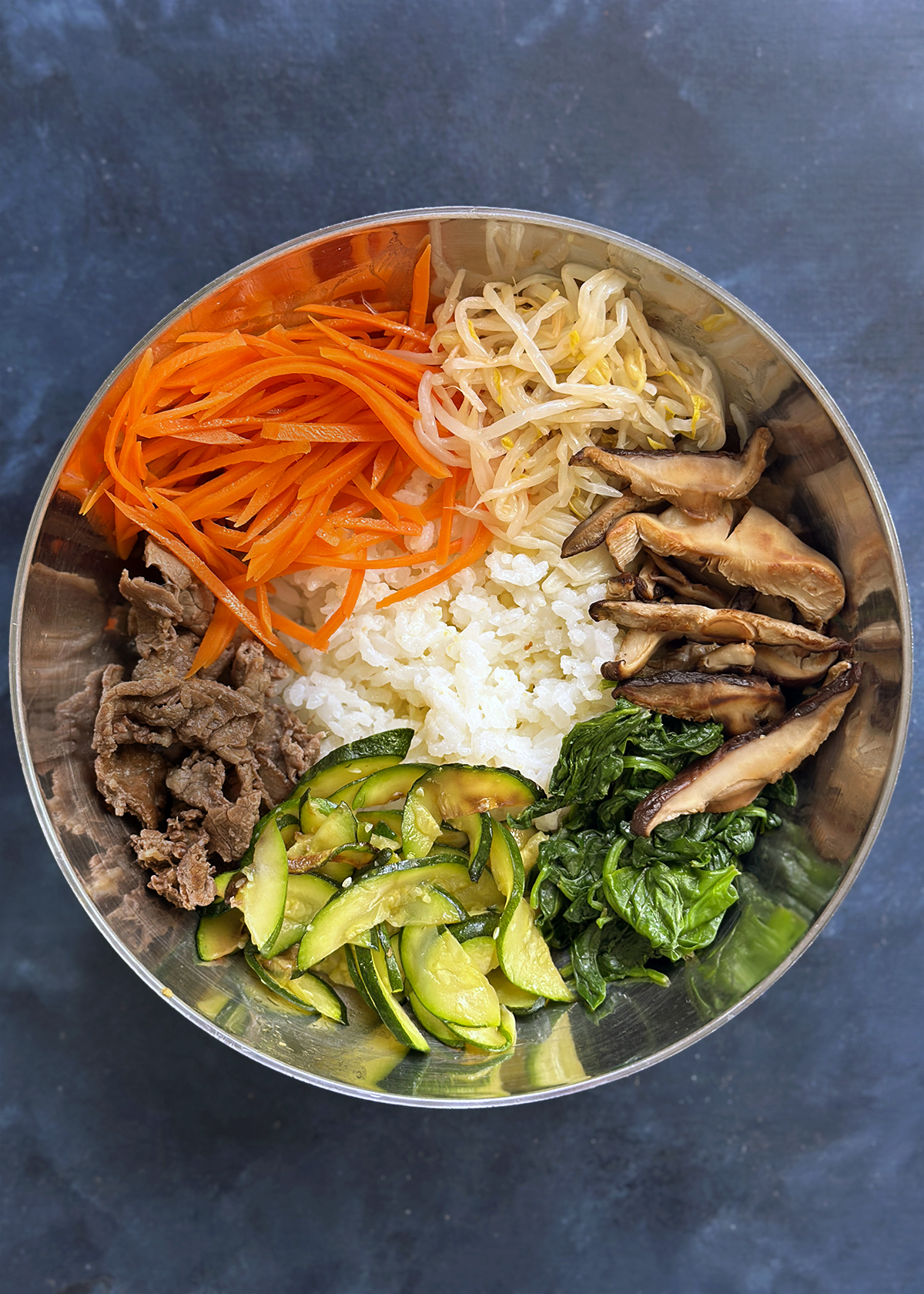
When ready to serve and eat, place ½ to 1 cup of steamed rice in the center of each serving bowl. Arrange vegetables and beef around the rice.
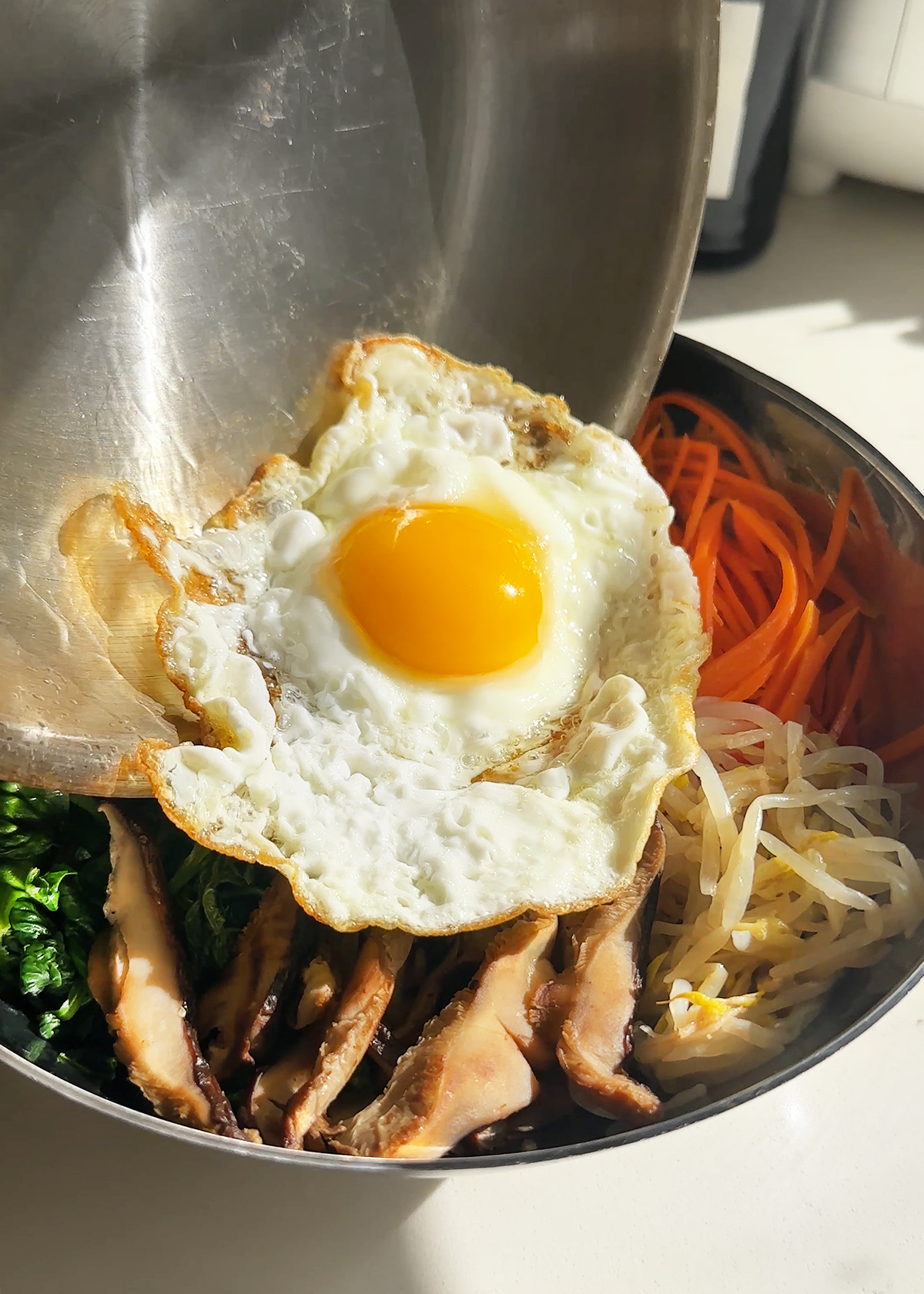
Place the sunny side up eggs over the rice in the center.
How to Serve and Eat Bibimbap
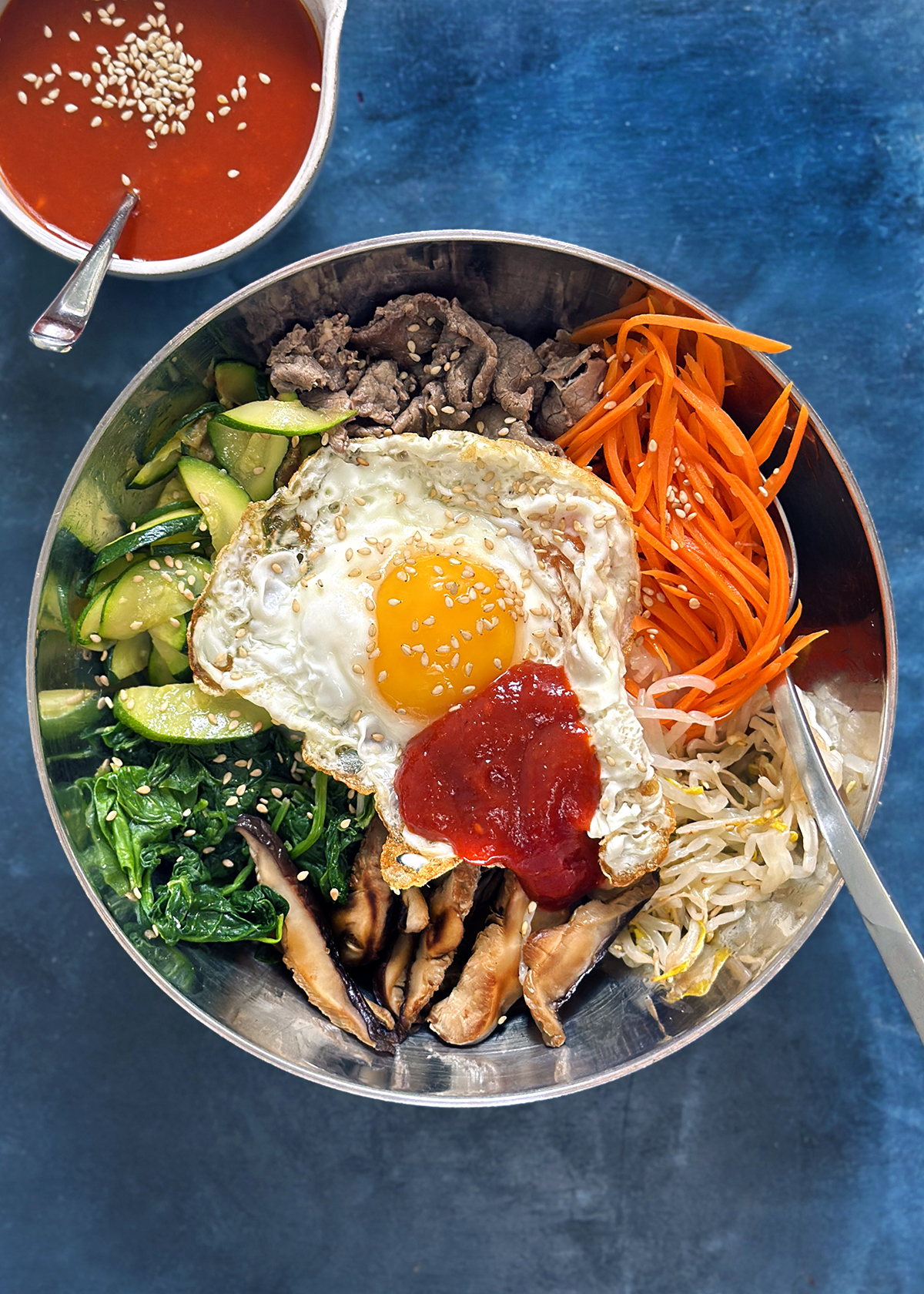
Dollop about 2 tablespoons of Bibimbap Sauce onto each bowl. Garnish with toasted sesame seeds. Serve extra Bibimbap Sauce on the side at the table.
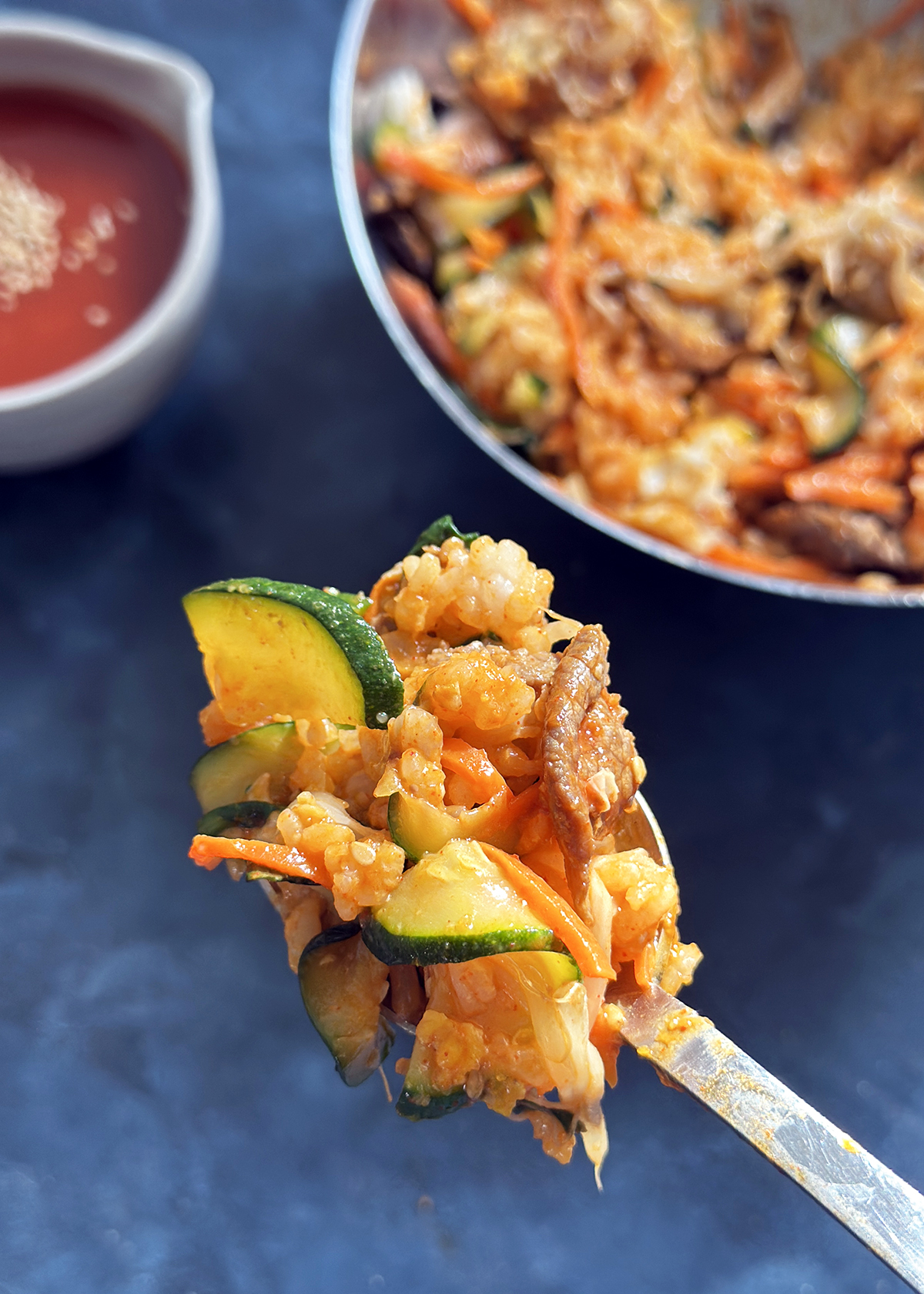
Mix all the ingredients in the bowl together and eat!
How to Serve Bibimbap for a Group or Party
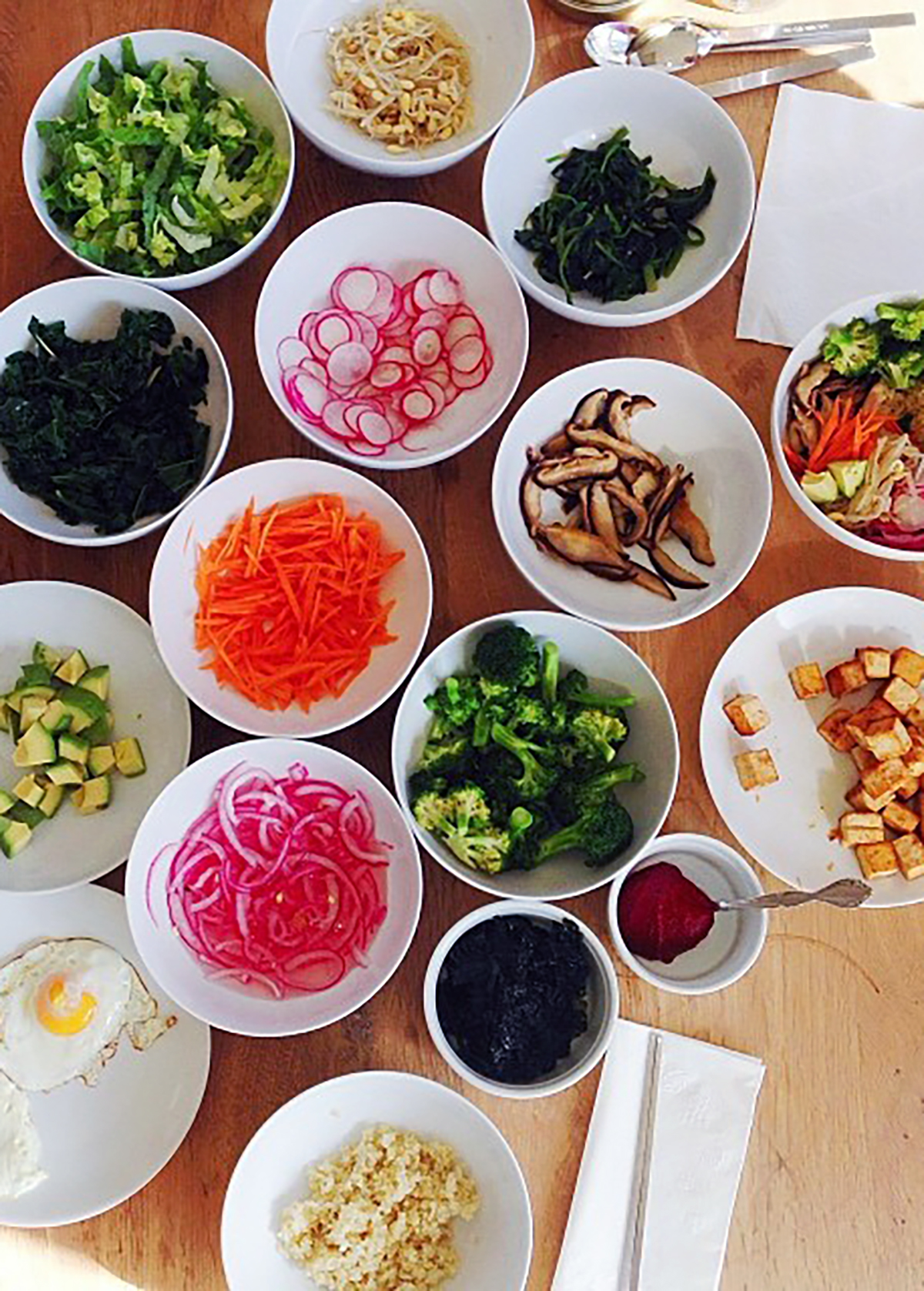
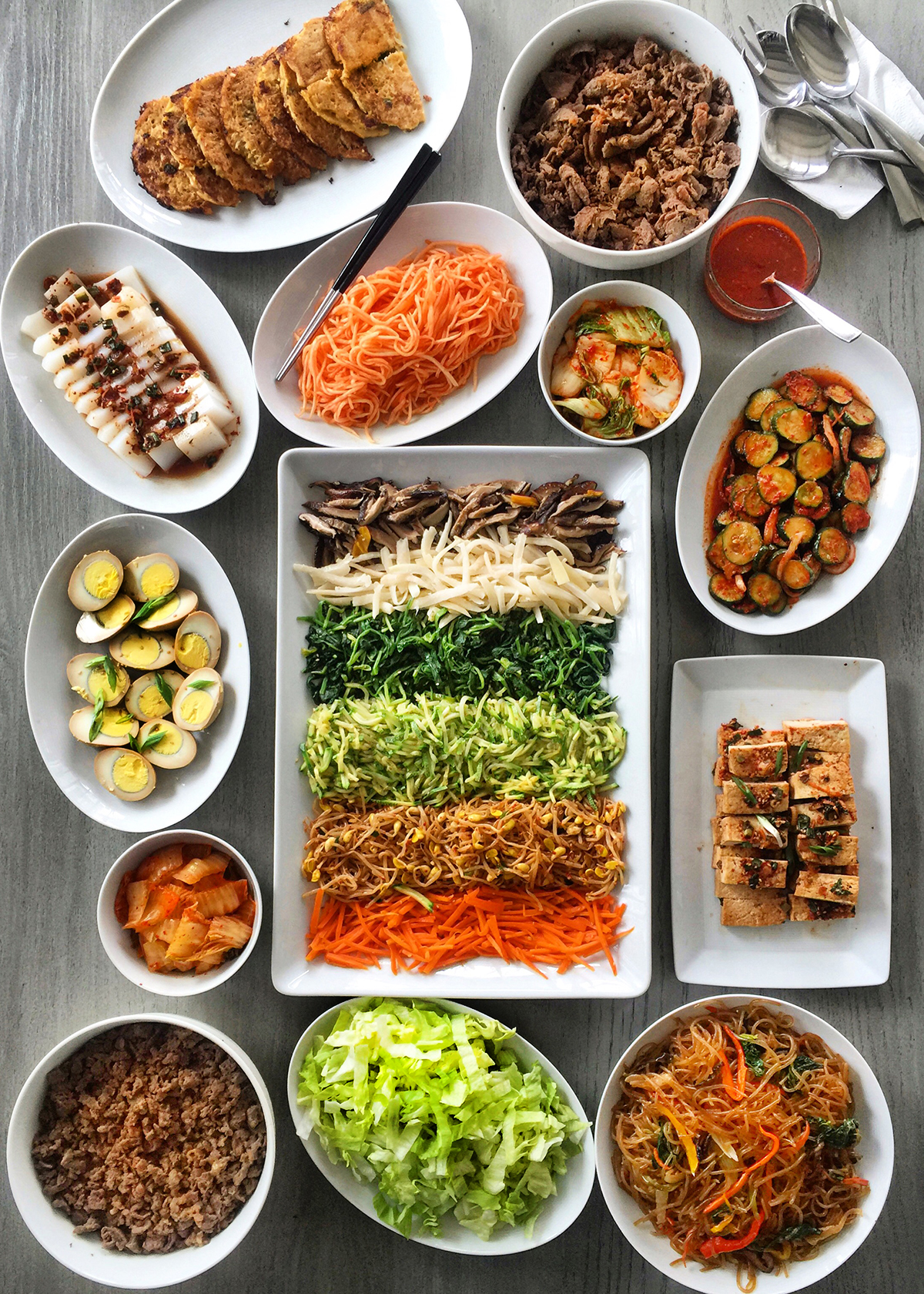
Pro-tip to Make it a Party: We call it a DIY Bibim-Bar! Prepare each of the individual ingredients in large batches, set them out in the individual serving bowls and platters like a buffet. Give each person a bowl with rice in it, then let them build their own Bibimbap Bowl!
Best Bibim Recipes
Traditional Korean Bibimbap Recipe
Ingredients
Bibimbap Rice
- 1¼ cup short- or medium-grain rice approximately 3-4 cups cooked
Bibimbap Seasoned Meat
- 8 ounces beef ribeye sliced paper-thin across the grain
- 2 tablespoons soy sauce
- 1 tablespoon maple syrup optional for added sweetness
- 2 cloves garlic finely minced
- ½ teaspoon fresh ginger grated
- 1 tablespoon avocado oil or other neutral oil for cooking
Traditional Bibimbap Vegetables
- 2 tablespoons + 2 teaspoons avocado oil or other neutral oil for cooking
- 2 carrots julienned
- 4 cups bean sprouts
- 2 large zucchini julienned
- 10 ounces spinach
- 2 cups shiitake mushrooms
- 2½ teaspoons sea salt plus more to taste
- 4 teaspoons sesame oil
Bibimbap Sauce ~ 5 minutes
- 4 tablespoons gochujang
- 2 tablespoons rice vinegar
- 2 tablespoons toasted sesame oil
- 1 teaspoon maple syrup plus more to taste
- 1 clove garlic grated
For the Bowl
- 4 eggs
- 1½ tablespoons roasted sesame seeds
Instructions
Cook Rice ~ 45 minutes (simultaneous)
- Rinse 2 cups rice under running cold water until water runs clear, about 4 or 5 times, then steam in rice cooker as per manufacturer's instructions, or cook on stovetop.
Marinate Beef ~ 45 minutes (simultaneous)
- Combine 2 tablespoons soy sauce, optional 1 tablespoon maple syrup if using, 2 finely minced garlic cloves, and ½ teaspoon grated ginger in a medium bowl. Add sliced beef, stir until beef slices are well coated with marinade on all sides. Using your clean hands to gently massage the marinade into the meat doesn't hurt! Cover and set aside for 30-45 minutes while rice cooks and you prep the remaining vegetables.
Make Bibimbap Sauce ~ 2 minutes
- Whisk all ingredients for the bibimbap sauce together in a small bowl or jar. Use immediately and store leftovers in an airtight container in the refrigerator to use on demand.
Prepare and Cook Bibimbap Vegetables ~ 30 minutes
- Bring a large pot of water to boil.
- Drop bean sprouts into boiling water. Return water to a boil, then turn down to a simmer. Blanch the sprouts until they are just beginning to wilt, about 10 minutes. Remove the sprouts from the pot with tongs, large slotted spoon, or small sieve, leaving the simmering water in the pot. Drain off or squeeze as much water from the sprouts as possible. Toss with ½ teaspoon salt and 1 teaspoon sesame oil. Set aside.
- Repeat the same cooking method for the julienned carrots. Carrots will take about 6 minutes until tendercrisp. Toss with ½ teaspoon salt and 1 teaspoon sesame oil, and set aside.
- Repeat process for spinach, which will blanch in about 2 minutes. Toss with ½ teaspoon salt and 1 teaspoon sesame oil.
- While you're waiting for the water to boil for the bean sprouts, carrots, and spinach, heat 2 teaspoons neutral cooking oil in a large skillet over medium high heat. Add zucchini to the pan and sprinkle with ½ teaspoon salt. Sauté until just the zucchini is barely beginning to soften and most of the rendered liquid has evaporated off. Remove to a small bowl. Toss with 1 teaspoon sesame oil and set aside.
- Add 1 tablespoon oil to the pan and swirl to coat the bottom evenly. Add the sliced shiitake mushrooms, sprinkle with ½ teaspoon salt, and sauté until mushrooms have cooked through and are starting to very lightly char at the edges. Remove from pan and set aside.
- Turn down heat to medium low, add 1 tablespoon oil to the pan. Fry eggs sunny side up. (I personally cook my eggs over-hard. Sorry not sorry!)
Cook Marinated Beef ~ 5 minutes
- Wipe out the pan to remove any errant burnt or crisped veggie or egg bits. Heat 1 tablespoon oil in frying pan over medium-high heat, then add marinated beef. Sauté until just cooked through, about 5 minutes. Total cooking time depends on how thick the beef slices are. Remove cooked beef from pan and set aside on a plate to cool.
Assemble Bibimbap Bowls and Serve
- When ready to serve and eat, place 1 cup of steamed rice in the center of each serving bowl. Arrange vegetables and beef around the rice. Place the sunny side up eggs over the rice in the center. Garnish with toasted sesame seeds if using. Serve with Bibimbap Sauce on the side at the table.
Notes
Nutrition
Is Bibimbap Healthy?
Bibimbap is considered healthy because of the nutrient density of all the colorful vegetables. With the inclusion of a whole grain and protein, bibimbap is a balanced meal. Depending on what your personal needs are, you can tweak and adjust the ingredients to promote and support your health or fit within your dietary restrictions.
Vegetables Rich with Antioxidants, Fiber, Minerals, and Vitamins. Depending on which specific vegetables you choose, Bibimbap is full of antioxidants, fiber, minerals, and vitamins. And because we're doubling down on the health factor for this Bibimbap, the cooked vegetable ingredients in this recipe are made by blanching in water rather than frying in oil.
Gochujang Has Probiotic-like Qualities. Gochujang is made by fermenting chili peppers with rice and/soybeans. As a fermented food, gochujang provides gut-health promoting probiotic bacteria. That fermentation gives gochujang its umami flavor, that salty, savory deliciousness that's hard to pinpoint in foods.
Dietary Considerations of Bibimbap
This recipe for Bibimbap is:
- dairy-free
- gluten-free if using gluten-free certified tamari or soy sauce
- refined sugar-free
Tools and Equipment

As I always say, you don't need any special equipment to make almost any recipe. However, that's not to say there are a couple of gadgets and tools that might make it a LOT easier to get Bibimbap from your fridge to fork, or spoon.
- Rice cooker. This Korean brand is the rice cooker I have in my kitchen. They offer a wide range of sizes, styles, and price ranges, everything from a small, sleek 3-cup rice cooker, to a top-of-the-line luxury beast of a machine that honestly has too many features that you know what to do with. I also have this Japanese rice cooker, because you know, when I make Japanese food, I use the Japanese one because I'm committed to the bit like that.
- Heavy bottom pot if you cook rice or grains on the stovetop.
- Colander/sieve to drain the boiled/steamed vegetables
- Extra large cutting board
- Mandoline
- Chef's knife
- Individual bowls
- Squeeze bottle for Bibimbap Sauce if you don't have empty, washed out sriracha bottles
- Mini ¼-cup liquid measuring cup
- Glass mixing bowls for prepped vegetables
- Glass storage container with airtight lids, perfect size for storing advance cooked ingredients, leftovers, and Bibimbap Sauce
** Pro-tip: Save your empty sriracha hot sauce bottles after you're done to use for Bibimbap Sauce! When you make Bibimbap Sauce, pour it into an empty, clean sriracha bottle and you can squeeze the sauce directly over your bibimbap bowls just like they do at OG Korean restaurants!
Advance Prep, Leftovers, and Storage
You can make almost all the ingredients in advance. In fact, you absolutely should make them in advance in bulk as "meal prep" for the week! You can prep all of the ingredients in advance and store them separately in air-tight containers in the refrigerator prior to serving.
Advance Preparation
Here's how far in advance you can prep the individual ingredients and keep in the refrigerator:
- Bibimbap Sauce: prep up to two weeks (14 days) in advance
- Steamed rice: up to 3 days in advance
- Vegetables except sprouts and spinach: up to 3 days in advance
- Sprouts and Spinach: 1 day in advance
Leftovers Storage
Refrigerating Leftovers. Use the above time guidelines for storage of leftovers of individual ingredients in the refrigerator if you cook on the same day you eat.
Once the Bibimbap has been served and mixed together, it will keep in the refrigerator in an airtight container for one day.
Freeze Leftovers. Steamed rice will keep in the freezer in airtight containers for up to 1 month.
The prepared vegetables can keep in the freezer, but it is not recommended because their textures will change significantly.
You can freeze Bibimbap Sauce for up to 6 months in an air-tight container with as much air removed. Thaw in the refrigerator. Microwave thawing is not recommended. Stir the thawed sauce to re-combine the ingredients before serving.
What Else to Serve with Bibimbap
An enormous bowl overflowing with a rainbow of antioxidant-rich vegetables, mixed with a metabolism-firing hot sauce is already an entire meal! But if you like to have a little side of either something cold and refreshing or hot and brothy to wash it all down, try these:
- Bone broth
- Miso soup
- Pile of kimchi is always a given, and can be chopped and mixed right into the bibimbap, too
- Tiny bowls of interesting banchan that's not already in the Bibimbap
- Gim, Korean toasted nori squares to wrap up the mixed Bibimbap
FAQ
If I did my job writing this post, all of your questions should have already been answered, but here are a few all in one place. And if any additional questions come up while you make this Bibimbap, drop them in the comments!
Bibimbap is a traditional Korean dish that consists of a bowl of steamed rice topped with a colorful assortment of fresh, pickled, and cooked vegetables, usually some kind of protein like tofu, beef, chicken, sometimes a fried egg, and hot sauce. All of the components of bibimbap are arranged carefully by color to serve, then mixed together in the bowl right before eating. "Bibimbap" translates literally from Korean "bibim" + "bap" to English as "mixed" + "rice."
One serving of Bibimbap as presented in this recipe has: 600-700 calories, 37 g protein, 21 g fat, and 7 grams of fiber. As always, these are estimates based on the recipe and nutritional data provided by the USDA.
Bibimbap Sauce, made with gochujang, Korean hot pepper paste, plus a few other ingredients is my personal favorite. However, you can also use gochujang, Korean hot pepper paste, straight out of the container as your sauce.
If you don't have gochujang handy, try sriracha, which is a Southeast Asian hot sauce with a higher-toned, vinegar-forward flavor. Alone, sriracha tastes very different from gochujang, which has a deeper-toned, earthy umami flavor. If you have access to miso paste, combine 1:1 with the sriracha to mimic the umami in gochujang. Chili crunch or chili oil will also work. In an absolute pinch, use any hot sauce!


nosheteria says
Whew, that's a long (but not too difficult it looks like) recipe. Thanks for the posting.
Peter says
Yum. Despite lots of bibim-bahp while in LA, the best I think I've ever had was in Boston of all places. I think at the time I was just discovering the wonders of Korean food, and bibim-bahp was the dish that really epitomized the experience for me. Thanks for an evocative post, and a great picture.
Josh says
sounds yummy..ill have to try to figure that into my rotation.
if you can get me the hurry curry, curry recipe..you'd score tons of points with me :)
Anonymous says
Wow I don't think I've ever seen banchans ever look so artistic before. Nice job! Now see if you can do that with doenjang chigae!
MEalCentric says
Funny how I was thinking about making bibimbap the other night and was glancing over on-line recipes. I noticed most either blanched or quickly sauteed the veggies. Also most incorporated soy sprouts (my fav!). But your recipe is so much easier with everything raw! Thanks!
sarah j. gim says
josh: i have my own recipe for curry, and it tastes somewhat like hurry curry's, just spicier (how i like it). though i want to find out how they get their chicken so f!@#in' tender.
mealcentric: actually, all the vegetables do require cooking, which is why bibim-bahp is such a pain in the patootie to make - have to use so many pots and pans!
Daily Gluttony says
awesome! can't wait to try it myself. anyways, i don't care about the tons of pots and pans to be washed...that's what the boyfriend is for. =P
tkic2 says
Just tried your recipe tonight with great success! Your blog is fantastic! :)
sarah says
tkic2: glad the recipe worked out for you!!!
kosari geek :) says
I love gosari!!! my grandma goes to parks and slips into the woods for hours at a time to pick the stuff!!! this is probably not legal, but she does it anyway. you're right the frozen, dried, and otherwise packaged gosari is pretty gross, but you can find it growing here in the states!!
when I was growing up, our church used to go on big picnics where we'd spend the day picking gosari in some random person's forestland. by the way, this was all in michigan so I don't know whether it grows in such abundance other places in the country
Anonymous says
The gosari should be parcooked in boiling water for about 10-15 minutes and it'll soften up. I don't know why cookbooks mention merely soaking it in hot water. That's just the first step and they're much more fibrous than dried mushrooms. Once the gosari has been par cooked it rids it of excess iodine and it can be cooked like any other vegetable.